Categories
Theory Application

How RPGs like D&D Help us Make Friends

I made a video about how RPGs like Dungeons & Dragons help people make friends based on sociological and primatological research. You can watch it below if you’d like.

If you’d like to read about it, please continue.

Friends are pretty great and If you’ve played any RPGs in the past then it’s pretty likely that you’ve developed some good friends in the process. But why? How does that work? Are RPGs really that good at helping people make friends?

Well, Yes, playing RPGs can meet all the conditions to help the people create long lasting friendships. But the interesting thing isn’t that RPGs do this. The interesting thing is how RPGs create friendships. In order to understand that we need to understand a few other things first. Basic things, like what is a friend and how friendships are formed and what purpose they serve on a biological level.

What is friendship?

Defining friendship as a social behavior is pretty simple. According to psychologist Robert Seyfarth: “Friendship is a long-term, positive relationship that involves cooperation.” He and a team of other scientists discovered that by researching primates. The team spent a great deal of time observing different types of monkeys and baboons in Africa and observed that animals with strong social networks, like friendships, have longer lifespans and actually reproduce more. Friends and people who we can rely upon are there to help us deal with difficult situations in life. And while most people aren’t worried about being eaten by predatory animals anymore, the stress response still exists in humans. So apparently one of the ways we cope with those stresses is to create friendship bonds with other people. We do this in order to help reduce the amount of stress we accumulate during our day to day lives.

How do we make friends?

Researchers have known for a while now what three key building blocks are that allow us to make friends.

Proximity

Repeated interactions

And

a setting where we feel comfortable enough let our guard down

And, you remember those monkeys that Sayfarth and his team were studying? They noticed several behaviors that helped to reinforce these principals. They discovered that those same monkeys spent a lot of time together. They saw that certain monkeys chose to spend time grooming other certain monkeys expressing preferences. Those choices of who grooms who eventually led to closer connections. But why does that matter?

Why do our friends matter?

Well, Sayfarth’s team found a few other conditions that were present when the monkeys were making friends. Namely:

The amount of time spent with friends

The positive outcome of that spent time

And

An equitable return of effort.

They noticed that the monkeys spent around 20 percent of all their waking time grooming each other. Looking at the response in the monkey’s neurotransmitters, or brain chemistry a positive outcome of all that grooming was seen. Their brains were releasing oxytocin and endorphins. These are the chemicals that help us to feel safe, cared for and help to create bonds with each other. After they spent enough time with each other the monkeys developed relationships that were equally helpful to both parties. But the final piece of the puzzle was an equitable return of effort. Because if one monkey spent a good amount of time grooming another and the favor wasn’t returned then a friendship wouldn’t develop. But the team found some monkeys would spend equal time grooming one another. That equity in grooming helped the monkeys to learn that their friend would help them and eventually help deal with larger issues. Like the stress of predation.

Humans have been at the top of the food chain for a very long time. Yet we still get stressed out. That’s because there are still loads of other stressors that we face on a regular basis. Each person has their own set of troubles and issues but they also have their own set of coping skills. When we have a friend though, it helps us to develop additional resources and help mitigate stress through interaction, because brain chemicals like oxytocin can help to alleviate the effects of stress chemicals in our brains like cortisol.

What does this have to do with RPGs?

Meeting new people is tricky and how do you know if that new person has anything in common with you? Well, sometimes it helps to have a way to jumpstart those relationships. This can be called a common interest. If you’ve read this far you are at least passively familiar with games like Dungeons & Dragons or some other kind of role playing game. So let’s consider what RPGs do through the lens of the traditional sociological understanding of friendship.

The original list had three qualities:

Proximity

Repeated interactions

And

a setting where we feel comfortable enough let our guard down

If you consider what a standard in person role playing group looks like you immediately can see how all three of those conditions are met. The people playing the game are in close proximity to one another. They’re literally at the same table.

Now there is some question, at least to me, about whether or not a group that meets completely online still meets the same criteria for proximity since the group isn’t in the same physical location but I honestly couldn’t find any research about the difference between relationships that exist completely online vs in person in this context for RPGs. From my own experience I always find myself creating stronger bonds with people that I meet in person at some point. That’s not to say that a completely long distance virtual friendship can’t be helpful or valuable, just that everyone has their own criteria for how much of that proximity needs to be physical compared to virtual. I’m gonna bet since coronavirus made us all experts on how to video conference there’s gonna be some really interesting research released in the next few years that addresses that specific question, but I digress.

Because whether or not your group meets in person or online their goal is probably to meet on a regular basis. If they do, then you can also tick off repeated interactions. Even if one or two people miss a session from time to time there is still an expectation that some day of the week, or month, time will be put aside for D&D or whatever you’re playing. This aspect of repeated interaction is, at least anecdotally, one of the things that people struggle with the most when it comes to getting into the RPG hobby, especially if they join the hobby after college and they’ve already got a full time job and a family. But assuming everyone can get some time on saturday nights the repeat interactions are taken care of. That just leaves an environment where people can feel comfortable enough to let their guard down.

Generally speaking, a table where people are playing an RPG is a pretty welcoming place. People are sharing a common story, building a world, using their imaginations, cooperating, collaborating and hopefully having a good time. People get to share their ideas and characters that they’ve created and tell a story that they find fun and engaging. That type of expression necessitates a certain level of vulnerability. If people are new to the hobby it may be tough to find a table to play at but once people do find a supportive table they still feel comfortable enough to let their guard down and share their creativity. At least in a perfect world.

Because all three of the traditional pillars of making friends are handled readily by a normal RPG table, but what about Sayfarth’s team and the monkeys they studied? Do RPGs still stack up with the other conditions?

Monkey’s and D&D

So remember, the pillars of monkey friendship were:

The amount of time spent with friends

The positive outcome of that spent time

And

An equitable return of effort.

Any RPG group that I’ve ever been a part of meets for at least two hours. When I was younger, those sessions sometimes lasted for an entire weekend. So of course the amount of time that a group of players and a GM spend together is going to be quite a bit. Factoring in the traditional idea of repeated interaction you can see that the amount of time people spend playing RPGs with their player group almost automatically nets them lots of points on their way to friendships. But time and repetition aren’t everything. Think about people who are out in the workforce. I spend at least 40 to 50 hours with the same people at work every week but I spend very little if any of my time out of work with them. Does that mean they aren’t my friends? Not necessarily. Everyone is different and people may indeed make lasting excellent friendships with co-workers but some work environments are very competitive. This competition means it can be hard to meet one of the original criteria for friendship, having a setting where people can feel comfortable enough to let their guard down. So even though we can spend a great deal of time with people, time isn’t the only factor that creates friendships; the environment plays a big part. Just think about school. You can spend years in class with the same people and not even learn their names.

That’s why it’s so important to remember the other parts of how friendship was observed with the monkeys. The positive outcome of time spent with people is a massive part of what creates friendships. At an RPG table the group is not in competition with each other or the game master. They are all working together in order to tell the same story. The positive outcome of which doesn’t have to be completing an arc or even keeping a character alive. The positive outcome is the social interaction that occurs at the table. I’ve played at a lot of tables where we spent a ton of time just talking about the rules, planning our next move or just going to a pub in game and pretending to order food. The plot may or may not move and the characters may be our focus or be completely forgotten, but the positive outcome of that social interaction is the release of those chemicals that help us feel safe and valued. Oxytocin and endorphins are released when we spend time doing something pleasurable like laughing, singing, and storytelling. I’ve done these things at the table before and if the vast amount of RPG content on the internet is any indication, I’m not alone. We enjoy RPGs because they help us to scratch a lot of social itches.

Which dovetails real nicely into the final part of what Sayfarth’s monkeys showed, an equitable return of effort. RPG groups allow for us to contribute to a story and bring our creative ideas to life. When all the players put forth effort and try to show the other members of the table that they care, players and GMs can hopefully see it for what it is, putting out effort. This may sound like trading off GM duties, but not necessarily. Sometimes people just prefer to run the game and sometimes people aren’t comfortable as the GM. Personally I don’t see anything wrong with that. I don’t think that a player needs to show they care by taking a turn as a GM. If a player wants to take a turn as a game master I would rather they do it because they want to, not because they feel like they have to or that they’ll lose friends if they don’t. Because people don’t always put out effort the same way. Some players know the rules, some are good at tactics, some take excellent notes and some always remember to bring snacks. There are so many examples and so many different ways that I’ve seen players show they care about the game and the people they play with. If we, as players and GMs take the time to acknowledge and appreciate the care and attention that the other players bring to the table then we are able to appreciate each other not just for the value we bring to the game, but the value we bring to each others lives. Because in my experience many of my lifelong friends have one thing in common. At some point I have played an RPG with them and during that time we were able to tick all the boxes that make up a friendship.
Categories
Book Report

The importance of consent in Gaming

In 2019 Sean K. Reynolds and Shanna Germain released the book Consent in Gaming through Monte Cook Games. The book itself is 13 pages (it’s actually smaller than that because the first page is the cover and the last page is a worksheet) and it explains the reason why the concept of consent is really important for RPGs like Dungeons & Dragons.

You can download the book here, it’s free:

Consent in Gaming

You can watch my review of this book

What is it?

Consent in gaming is an introduction to the ideas of consent and self respect, and how they’re both applied to RPGs. The book is organized into several sections. It opens with a description of what consent is, just in general, things like why players should have the default framework of opting in to certain parts of the story and why anyone can change their mind about what they’re comfortable with at any time. The next section moves on how to have conversations with your players or your DM and operationalize consent at the table. The authors provide some suggestions for using ideas like go and no go words, the X card and utilizing a consent checklist. Following that, the authors share a few ideas on how to have conversations with your players or DM when someone crosses a consent boundary. Then the book ends with some resources for GMs to use at their table to discuss the ideas for consent. Including a very useful worksheet that can help players to start their own conversations with their DMs about what may and may not be okay at their tables.

What this book does, in less than twelve pages, is distill down all of the excellent reasons why understanding and using informed consent can be helpful to you as a GM. When I’m a DM I want to know what my players are looking for in a game. I also want to know what my players DON’T want. So when I’m running D&D for a new group I’ve never met, I really do want to know where those lines are. The authors do a really good job of explaining how to find those lines and recognize when to use them in the creation of a story or when running a game. They include several examples of how consent is already utilized in games like No Thank you Evil and how GMs can help to resolve any accidental inclusion of topics that were deemed off limits. Personally, I feel like this book should be required reading for anyone who is thinking about getting into the RPG hobby.

But there’s one really big chunk of goodness in this book on the very last page. The RPG consent Checklist. To me, this sheet is really valuable and I’ve started using it in almost all my games. The sheet itself asks four questions and then has 6 categories of topics. The top of the sheet asks the GM and the player to put their name down. The player actually doesn’t even have to if they feel like they want to remain anonymous. The theme of the game is also requested, so this is where the DM would put down something like “Swashbuckling Trash Truck Drivers” or “Gritty noir mystery”. Then there’s a section where the GM can put down a perspective rating for the game like PG,PG-13 or R.

The real goodness of the sheet lies in the columned categories. These categories are Horror, Relationships, Social and Cultural issues, Mental and Physical Health and some blank spaces for additional topics. Each of these categories have a small but comprehensive list of several different things that players may be okay with or not okay with. The players can fill in one of several different colored boxes. The green squares represent enthusiastic consent, Bring on the Goblins! The yellow triangles represent a tentative consent, so something like a character getting kidnapped could happen off screen. The red circles represent a lack of consent or a hard no.

Each category has several examples that players can choose to consent or not consent to. They also have some blank spots at the bottom of each category so that players can add their own things that may not be listed. Having these lines of what is and is not okay for players is really helpful. Knowing where my players will start to feel uncomfortable is a great asset for me because I can really focus on the areas my players want to spend time.

What is it not?

This book is not the downfall of the RPG hobby as we know it. When it was released back in 2019 these authors caught a lot of heat. There was a great deal of wailing and gnashing of teeth about how thin skinned that people have become. I really don’t like the idea of labeling the RPG hobby as full of misogynistic reactionaries. Especially when most of the reactions to this book were on places like reddit (not here on DM Academy) where posts are anonymous. I also know that not everybody has the same reasons for objecting to why consent in gaming may be a worthwhile book. All people are different people.

Consent in gaming is not a way to learn about what your players don’t like only to use against them in the future. If you do choose to use the consent checklist and you intentionally choose to include a topic that one of your players has marked in the red. That’s not just including some fear in your game to raise the stakes, that’s being intentionally cruel to your players. Don’t do that.

This book is also not censorship. The authors are not saying that GMs should no longer include any specific theme in their games. The idea of consent that they are promoting is only that DMs and players be sensitive to what each other are comfortable with.

This book is also not just for people who are using RPGs in an educational or therapeutic setting. The ideas in Consent in Gaming are applicable to all tables.

Lastly, This book is not required. It doesn’t need to be used in all games and you are not a bad person if you choose not to use it. Because you have every right as a GM or a player to not use this.

Should I buy it?

I think this book is worth reading. Even if you don’t plan to include the consent checklist in your game the book still has a lot of very good points that I think all DMs should be aware of. Even if you don’t like the idea of this book I think you should still go read it, if only to better understand what makes you uncomfortable about it.

Other than it just being good manners to not make people feel creeped out, the book helps GMs, new and experienced, to think about the idea of consent. This book is free. Literally. It costs you nothing but time to go and read it. The authors did a really good job of breaking down the idea of consent into something applicable to RPGs and they gave it to the world. Because understanding consent isn’t something that should be behind a paywall.

Categories
GM Tips

My Favorite House Rules for Dungeons and Dragons

I wanted to talk about my favorite house rules I like to include when I run D&D 5e.

A house rule is a modification to the official rules for whatever system you’re using. Sometimes these rules are just favorite modifications to the official rules that everyone at the table likes, Like the hat trick instant kill that I’ll talk about a little later. Or they’re a collection of rules that make so much sense they eventually make it into the official game like what happened with Pathfinder Unchained.

Some of the rules I love are holdovers from other systems like Pathfinder or older editions of D&D but I like to use them because it allows for players to either get more involved in the game or to feel more comfortable at the table.

House rules are not not official. This means that before you bring any of them into play at your table you need to make sure that the players agree to using them. Use your best judgement about how to ask your players but for the most part you want to check with them before play begins, not right when a house rule would come into effect. Nobody likes the rules changed on them at the last moment.

If everyone is on board with the new rules, then go for it. If someone isn’t on board for your house rules then you probably shouldn’t use them. There are very few exceptions to this, but generally I try to look at house rules as a possibility, not a certainty. If you’re a GM and people have come to you in order to play D&D it makes sense that they would expect D&D and not a modified version of the game.

I made a video about this if you’d like to watch it here:

Critical failures

Even though the rules in 5th edition don’t stipulate critical failures are a thing, unless you count the brief paragraph in the DMG, I still like them. I believe that there is something to be gained from failure, even if the failure is caused by random chance and there isn’t anything to be done.

Small failures help me to appreciate the big successes.

Which is why one of the house rules that players can choose to adopt is the inclusion of critical failures. The point is to emphasize the lack of control. Just like a player can’t control when they roll a natural 20, they cannot control when they roll a 1.

Out of combat a critical failure would sometimes mean getting lost, or breaking a piece of non-magical equipment. It’s kind of tough to navigate in the dark if your oil lantern got stepped on by a horse. The failure should be something that will inconvenience the player but not render their character useless.

In combat it’s very simple:

A natural 1 ends your turn. No broken equipment, no getting knocked prone, nothing that has lasting impact beyond the player’s turn. It can be something as simple as a stumble or a bungle that means the player needs to end their turn as soon as they roll a natural 1.

The important thing I keep in mind about this house rule is that I need to describe what happens to the player and why they need to stop and end their turn. If they roll a 1 on a combat maneuver, maybe they stumble and take the rest of their turn catching their balance, maybe they sneeze, maybe their sleeve gets wrapped around their hand and they have to take a few seconds to untangle it.

Critical Success

So if my party chooses to include a critical failure in their rules then it makes sense that they would also choose to include a critical success. Which would of course come when they roll a natural 20.

Most of the time a critical success can find its way into combat easier than anything else. In the 5th edition player’s handbook a critical hit happens when a player rolls a natural 20. The player doubles up the damage and continues on. However, to me a natural 20 is a rare and beautiful thing. If my party is choosing to be burdened by a critical failure they should be given the opportunity to revel in a critical success.

So here’s my house rule.

A Natural 20 is a critical hit and they will get their damage doubled. However the player gets to roll again. If the second roll also meets or beats their target’s armor class, they get to roll percentile dice then pick a critical hit effect off of any number of critical hit tables available online. Some of you may be saying, “Hey I recognize that from Pathfinder?!” and you’d be right. Pathfinder is awesome and there are many other things that it does very well.

Because if they roll a second natural 20, they get to roll one more time. If they roll anything other than a third natural 20 then nothing happens and they can move along with their critical hit. But, if the player rolls three natural 20’s in a row. It’s an immediate instant kill of whatever the players are fighting. So that would be one natural 20 for the first attack, another natural 20 to confirm the critical hit, and a third natural 20 to bring it home.

Choose your own ability scores.

Lots of players come to the table with ideas for characters already in their minds. Sometimes these characters have been thought up days or even years in advance. So when it comes time to create their character it doesn’t make sense for them to roll up a random set of ability scores and leave their character creation to chance.
You can use a point buy to help players build up their character, but if a player already has an idea for the character they would ideally make, then I let them choose their own numbers. The only thing they need to do is explain to me why they chose those numbers and why they make sense for their character. This expectation of explanation has almost always resulted in very well rounded, thought out characters. Sure sometimes I get a character that is juiced to the gills, but the player is usually doing it as a joke. Almost all the players I’ve worked with have thought about their characters enough to decide what they want their characters to be exceptional with and what they want their characters to be unexceptional with.

Additionally, if a player insists on having massive stats it’s okay. It just means that I get to use more challenging monsters which is more fun for me.

Descriptive Helping

The help action in 5th edition is really nice. It allows for players to give each other advantage in and out of combat. My change to this rule is pretty simple. If a player says,

“Can I help?” I usually respond, “Sure, how are you going to help?”

Because in my house rule, In order to achieve a successful helping action a player must describe how their actions will aid the other player. This can be as simple as the barbarian distracting a noble while the rogue picks their pocket. Or the wizard creating light for the ranger while they track an animal. In my opinion, those types of small descriptions offered by your players can help them to get involved more deeply into the world they’re playing in.

Alternatively, if a player isn’t comfortable describing how they would help I would ask them to think about how they want to assist and choose a skill they would want to use in order to help. If the player isn’t comfortable with picking a skill or is new to the game, I may even suggest that the player they’re helping pick a skill they can roll for them. For example if the bard wants to help the fighter in a pit fight, but the player with the bard doesn’t know what skill they want to use for help, the person playing the fighter may suggest the bard uses performance to toss out an insult or rally the crowd.

No PVP without consent:

Players wanting to fight each other is nothing new. If you have two barbarians in the party they may want to see which one is tougher. However, if only one of them wants to get into combat there can be a conflict.

Sometimes players having some conflict out of game can manifest itself in game. Sometimes it’s a snide comment, sometimes it’s full blown shouting match. Sometimes a player may feel like they are angry and they express that anger in game. Other times a player may feel like their anger towards another character is acceptable in game.

I’m not perfect in this myself, I’ve let combat between players happen and sometimes it can lead to a benefit between players, but most of the time it leads to more conflict between the players and less fun for everyone involved. It’s okay to be angry, but it’s not okay to hurt others. It can also disrupt the game for other players when some people are taking out their frustrations on one another.

So, in order to help minimize this I have a pretty simple house rule. I don’t allow in game PVP between players unless they and I agree that they want to fight. Even then, I don’t allow the combat between the players to extend into deeply aggressive space. Player vs player combat is one of those things that requires a great deal of trust between the entire group, GM included, to be used effectively.

If the combat fits into the narrative and both players are comfortable. There’s no reason for them not to fight. However, if one of the players doesn’t want to fight then it’s my job as the GM not to question or coerce. A player doesn’t need to give a reason why they don’t want to fight. It’s just not going to happen. No judgement and from anyone needs to happen. This also means that if a player wants to fight another player and they’ve agreed to it in the past it also doesn’t mean that they agree to it for all time. Each instance of PVP needs to be completely consensual.

Categories
Theory Application

Trust at the RPG table

Why does trust matter between a GM and the players?

Trust can help create a sense of security for players to feel like their ideas will be heard and generate a sense of predictability in game.

An RPG table is a place full of wonder, intrigue, fun, laughter and perhaps most importantly, vulnerability. The relationship between the GM and the players requires that each person give of themselves. Sometimes it’s creativity in world building, sometimes it’s taking the risk of using a funny voice or accent. In each case showing a creative idea at an RPG table requires people to be vulnerable. Some ideas require more vulnerability than others, but no matter how much a player feels vulnerable a solid foundation of trust can help players to feel comfortable enough to express their ideas.

I made a video about this topic and you can watch it here if you’re interested.

In the video I talk about a few different things like:

Power dynamicsAs a GM you are someone with authority. Try not to abuse it. Players naturally know less about the world and therefore have less power than you. Try your best not put players into situations where they are uncomfortable.

Carl Jung expressed his opinions on power dynamics very effectively when he developed the three conditions of person centered therapy. I try to remain true to these conditions as a GM to keep the game focused on the players. Here are the three conditions:

Unconditional Positive Regard is when therapists/GMs must be empathetic and non-judgmental to convey their feelings of understanding, trust, and confidence that encourage their clients/players to make their own decisions and choices.

Empathetic Understanding means therapists/GMs accept their clients’ thoughts and feelings. This acceptance may push a GMs boundaries but that initial empathy helps to avoid a sense of moral superiority or condescension from the therapist/GM.

Congruence is when a therapist/GM carries no air of authority or professional superiority but, instead, presents a true and accessible self that clients can see is honest and transparent.

Group Norms/Informed Consent

If you’re starting with a new group of players for the first time, talk with your group during session zero and establish some ground rules for the game. This is not an essential step for all groups but some small time given to this in the beginning can help hold group members accountable.

This is especially helpful if you are running a game for people you don’t know. Consent helps to resolve some disputes because it helps players and GMs to know when certain lines are crossed and helps to keep people accountable. There is an invaluable resource from Monte Cook games about this topic that I suggest you take a look at if you’re interested in learning more about this idea.

You can find a link to their resource here:

Consistency of the Rules

Nothing stings a player more when the GM changes the rules for one player and not another. Some groups are only by the book and are less flexible regarding rules during the game. You need to determine what kind of game you are planning on playing. If you do change a rule record that change and try to be consistent with it. If you are corrected by a player be open to the correction. Don’t just smack it down if it’s inconvenient.

Regularity of Sessions

Set a scheduled game and establish when it will occur. Stick to that schedule. If people back out or flake out that’s fine, but if you care about running a game this step will help potential players know how serious you are.

That does not mean that you cannot cancel sessions if you need to, but it does mean that as a GM you need to be conscious enough of your own schedule and level of energy to commit to running a game as regularly as you feel comfortable.

Mixing up Facts

If your player needs to pray to their god in order to activate a divine ability. don’t punish them if they forget the name of their god, or mispronounce it. Nothing erodes trust faster than punishing a player for something small and inconsequential.

Model the behavior you’re looking for.

“Play is often talked about as if it were relief from serious learning, but for children play is serious learning. At various times play is a way to cope with life and to prepare for adulthood. Play is a way to solve problems and express feelings.”

– You are special, Fred Rogers.

Nothing speaks more loudly than the Game Master’s behavior, which influences player action and has the potential to drive their choices. If you say teamwork is important, reinforce the point by rewarding teamwork with your players. Or show a group of NPCs using the behavior you hope your players to emulate. Give credit when people do great work and you’ll set the stage for an appreciative culture.

Categories
Theory Application

Active Listening as a Game Master

Listening to your players is a key component of being a successful game master. Listening successfully means, being able to not only listen to your players ideas but also devote your attention to them enough so they feel heard and valued. Something that has helped accomplish this over the last few years has been something called Active Listening.

For those that may not be familiar with this idea I made a video about it that you can watch here:

Breaking down the idea of active listening can be accomplished with a few basic ideas:

Active listening refers to a pattern of listening that keeps you engaged with your players (or someone else) in a positive way. You will be listening attentively while they speak, trying to quiet your own mind and withholding judgment and advice.

The most important part of that definition is listening attentively while someone else speaks. A lot of the time when people are having a conversation one person is just waiting for their turn to speak, or as they’re listening to another person they’re building their own set of information in order to best or one up the other person. That’s not to say that kind of conversation is bad or unreasonable.

I know I used to do that all the time and I still do find myself doing it from time to time. But the thing about active listening is that when you’re doing it, you’re devoting your attention completely to what the other person is saying instead of just waiting for your turn to speak.

This may sound obvious, but it can be harder than you think. When I’m running a D&D session I want to listen to what my players are saying because I want to use their input in the game. However, there is also a deeper level to it that I try to keep in mind.

The most important and most difficult part of listening is learning how to shut down your internal dialogue while listening. Try and avoid thinking about what happens next in game and just listen to the player. It is impossible to attentively listen to someone else and your own internal voice at the same time. This may seem obvious but it’s actually quite difficult and can take a long time to learn how to do.

Something else that can be hard sometimes is being open, neutral, and withhold judgment while listening. As a Game Master your job is to be the storyteller of your universe. To me, that usually means striving for some measure of neutrality and impartiality between the players and their ideas. So weather or not you feel like their ideas are stupid or disruptive try and give your players the benefit of the doubt, at least initially. If you have a player who is being intentionally disruptive you can and should step in to have a conversation with that player. But most of the time, if a player has what you may consider to be a “bad idea” try and reserve your initial judgment.

Something else that can make a big difference for listening to your players is your comfort with silence. It’s okay to be okay with silence. When a player, or you, for that matter need a moment to think about what comes next you can allow for some silence. Letting people think doesn’t stop the game from progressing. Sometimes the difference between a player losing focus and a great idea is just a few moments of silent contemplation.

There’s a lot of moving parts to active listening but I think it’s an important skill that can really help GMs learn how to bring their player’s ideas into your story and your world. A player who feels validated and listened to will usually, in my experience, be more involved in the game.

Categories
One Shot Games

Start Your Game with a Shipwreck!

Starting a campaign is oftentimes the toughest step for any GM. If you’re building your own world or writing your own adventure you may have your big bad figured out, you may know your all the backstory of your NPCs and you may have given motivation to all the different powers that will be trying take down or help your players. But how do you start? Where do you begin?

That can be a tough question. It has been for me and over the years I’ve used and had GMs use with me a few truly excellent methods of beginning a new story. So I made a video about it in order to share some of them. You can watch it here.

The thing about the beginning of a story is that it helps to set the tone for how the rest of the game will play out. And while it’s true that you can pivot the tone of a game from session to session the beginning of a game helps players know what to expect. Will this be a game full of comedy? Will it be gritty and realistic? Or will it be something completely different?

However, the biggest thing to keep in mind for me is what is going to be happening right at the beginning. What are you going to describe to your players to get them hooked. In order to do that I want to describe something I first learned about in my screenwriting class.

Ab Ovo vs In medias res

Some of these game ideas will be a mellow starting point before any conflict or action sometimes called ab ovo meaning “from the beginning” and others will begin with the action and conflict already in motion called in medias res meaning “in the middle of the narrative”. I briefly want to explain the difference.

Ab ovo is a starting point for a game that begins at the very earliest chronological point. Consider the very beginning of Stargate, Moby Dick or Black Panther. In those examples there is no danger at the beginning, the conflict may be completely absent or very low key if it’s present at all. Similarly a game that begins ab ovo will usually begin where all the players may or may not already be together but the group probably isn’t in any immediate danger. They can get their bearings, maybe buy equipment or have some opportunity for non-combat roll playing. In RPG terms the stereotypical beginning of a lot of D&D games where your group starts in a tavern and you are hired by a wizard to go snag a magical artifact from a nearby dungeon is an ab ovo beginning.

In medias res represents the beginning of a story where something is already happening. It doesn’t necessarily mean violence but it does mean action. Some examples of this could be the iliad, Captain America or Star Wars (episode 4). Starting a story in the middle of the action can be jarring, but it’s supposed to be. By starting in the middle of a scene with no context the audience is forced to pay attention to what is happening. This initial hook, some believe, keeps the audience’s attention further into the movie and makes them want to know more about how the story will conclude. In Shadowrun terms this would be like starting your new campaign in the middle of a run. The players are already on the board and they’re carrying out their plan.

By putting your players in immediate danger, or at least the possibility of danger, they have to get their game faces on quite quickly.

I wanted to mention that these ideas are not unique to any one system and I’ve used these in multiple systems with more success so I’ll label them accordingly.

Shipwrecks

In medias res or Ab Ovo

(D&D, PF1e)

The nice thing about a shipwreck is that it’s a pretty universally understood concept that most people have never experienced themselves. This leaves you open to bending the experience to your will as a GM and your players will most likely be able to follow along.

I’ve used this idea in both in medias res and ab ovo.

  • The in medias res version begins during the shipwreck and your players need to find their way to safety right away.
  • Ab ovo begins after the shipwreck already having occurred.

In both cases it’s up to you how heavy handed you want to be with your players and the consequences of the shipwreck. Did they lose their equipment? Did they get injured? Could they actually die?

The nice thing about shipwrecks is that they don’t need to all be caused by the same thing.

  • Mutiny
  • Pirates
  • Sea monsters
  • Rocks

Shipwrecks don’t even need to be ships. The whole movie of flight of the phoenix is basically a shipwreck in the desert. But the ship is a plane.

When I’ve used this introduction with D&D and I’ve begun it in medias res. I’ve tried not to kill anyone. So far I’ve been successful in the few times that I’ve used it. But the important thing to keep in mind about the shipwreck is your eventual goal of the party. Make sure you read all the character sheets in advance and know at least one way they could escape or survive before you strand them. If your party’s goal is to escape the environment make sure you have a way set up for them to get out.

In Prison

Ab ovo

(Shadowrun 5e, VTM, D&D)

Starting a game with your players locked up can be an effective way to kick off a campaign. Prison is terrible but it does allow for a great place to pick up your characters and give them common cause. Are they all convicts? Are they all innocent and falsely imprisoned? Is there a mix? No matter the case your players can use the location to build a relationship with each other and the NPCs around them as they either attempt to break out, take over the prison or clear their names from within..

Honestly each time I’ve used it the game doesn’t stay in prison for a very long time. Whenever I use it the players inevitably want to escape and go do other stuff, like clear their name, but it still allows for a bond to be formed between player characters quickly. Just make sure that if you do use this starter you make sure your players have a reason to stick together after they escape. Maybe they all have an axe to grind for the person who put them in prison or maybe they all learned the location of something like D.B. Cooper’s lost millions while they were locked up together. This common purpose can give you an opportunity to introduce a primary plot for your campaign, something conflict with another group of NPCs, maybe throw in a villain for your campaign or perhaps create alliances between characters Either way, prison is a starting point, and finding a reason to stay together is worth considering unless you’re running a one-shot where your group needs to escape from prison.

You could use this starting point in medias res with something like a prison riot happening, or maybe your players are all getting processed into jail at the beginning of the episode. However, beginning in jail has always been an ab ovo starting point for me. If you do find a good way to start this in medias res, feel free to let me know in the comments.

Escort Mission

In medias res or Ab Ovo

(Shadowrun, Starfinder, D&D)

Your party has been hired to escort a shipment of goods, people, or something else from one point to another. This starting point is tried and true for me. I’ve used it a lot.You can start at the beginning of the journey and give your players a chance to gear up. You can start mid journey just before an attack You can start mid journey after an attack with your players having already taken damage and used spell slots or some of their gear if you really want to take up the difficulty a level. Upon completion of the mission your players get paid and can decide to work together again or the adventure can end there.

I like to add a little extra flavor to this one when I use it and preview a location that the players can return to later. Maybe they chase a creature into a cave that turns out to be a larger dungeon crawl if you’re playing D&D. Just keep in mind that, like prison, your players are going to need a reason to stick together once the initial mission is completed.

Party/Special event

Ab ovo

(VTM, Mage TA, Shadowrun, PF1e)Starting your players in a town/city location for a shared fancy event is a great way to have all the players of various backgrounds in the same place at the same time. The players all have a different reason to attend the party and once they arrive the story begins to unfold.

Sometimes this means that the party gets crashed by ninjas or that the party members are honored guests who have social obligations that they get to use to advance their own agendas. Your players can also be pretending to be event staff to gain entrance to the party or they may even be event staff that get swept up into the adventure.. This one is very flexible and can vary depending on who your players are. If you have a good sense of where you want the game to progress and are looking for a way to introduce a lot of NPCs very quickly and set the social tone for your game a party and special event can be perfect.

Rescue Mission

Ab Ovo

(Shadowrun, Spycraft)Have you ever had a first session where you know one of your players isn’t going to be able to make it? If you know far enough in advance you may want to consider a rescue mission. Your current players need to rescue someone. Whether that person is a member of their team currently or they’re just hired to go rescue this person your players will have to complete a mission without this player. Once the session is over and they have rescued the person you can begin the next session with a full group and your newly rescued player can have some kind of vital intelligence to provide to the rest of the party.

Hunted

In Medias Res

(D&D, Shadowrun, VTM)

I LOVE this starting point. This starting point does provide a bit of lore and supposes that you can shoehorn this into your own story. Taken on it’s own it also provides the making of a pretty good one shot.Your players awaken, in an environment of your choice but have no idea how they arrived there. They are accompanied by one or two NPCs who also have no knowledge about where they are but can be used to provide clues. Your group is being hunted by an OP creature or group of creatures and the party has to escape or fight back. It’s more fun if the creature only responds to things like noise or magic or attacks people with weapons. Basically I’m recommending you put your players through a predator movie. You can always kill off one of the NPCs to drive home the danger of the environment as well. You can run flashbacks with your players individually later in the game if you like to help give clues as to how they arrived.

Escape the disaster

Ab Ovo

(D&D, VTM, Shadowrun)Kick off the campaign with a natural disaster. The disaster can be something localized like a tornado or it can be something much larger like an earthquake that triggers a volcano and a tsunami. No matter what your disaster is remember to keep the danger present. Buildings falling, things on fire, water flooding stuff. That kind of chaos helps to create disorientation and your players will have to either work together to help the people around them or they will need to escape to save themselves. Either option is perfectly acceptable. You are not a bad person if you want to escape. If your players do stick around to help people they can receive some bonuses when they disaster is over. Maybe they are remembered as heroes, maybe they have new allies.

If you really want to pull the rug out from under the players. Maybe the villain used the cover of the disaster to assassinate someone, kidnap someone, or do something else to cause conflict and motivation later in the story. Maybe they even started the disaster somehow, if you’re playing in a magic setting.

This can be a tough game to start with if you have a player in your group who has survived a natural disaster so remember to be sensitive to that.

OVERLOAD!

In medias res

I’ve done this a few times but I really enjoy mixing and matching some of these different beginnings. Choose two of these and mix them together to give your players something with a larger challenge. Nothing says fun like trying to rescue a missing team member during an earthquake. Combining different tropes like the ones I’ve talked about can give rise to new ideas and maybe help you create some stories of your own.

Final Thoughts

Starting the campaign can be daunting but with some of these ideas you can start your party with a bang. Just because you start a campaign in a certain way doesn’t mean that it has to be the dominant tone of the entire campaign. Any of these ideas can be played to their conclusion or abandoned halfway through for the pursuit of a larger plot. The idea behind all these suggestions is to give your players a jumping off point that can help them feel invested in the story and start the growth of their characters.

Categories
GM Tips

Last Minute Player Cancelations

We all have issues with our players not showing up. Players cancel at the last minute for lots of reasons. If your players flake it can leave you with questions:

  • SHOULD the game master even feel bad in these types of situations?
  • What should the game master do/how should they react in these situations? Is putting the “big campaign” off the table the right compromise to make?
  • Is there anything that could be done to avoid these situations or do they “just happen” ?

Well the short version is no, the game master shouldn’t feel bad, putting the campaign on hold may be the right call and you may be able to do something to help with this some of the time but things do happen.

I made a video about this and you can watch it at the link below if you like.

Or you can feel free to read along below!

If I know that some of my players aren’t going to attend I have already made a cut off point in my mind and that’s what I call the ⅔ rule.

The “2/3 rule”. If more than 2/3 of the group will not be present then we do not play the main story. I personally don’t think it’s fair to advance a story without more than 2/3 of the players present. So this would mean if I have a group of 6 and 3 or more players are missing I don’t play the “Big Game”. This isn’t meant to be an ultimatum, just a way for my players and I to know what the game night will be like if we don’t have a full group. If you let your players know this at the first session or the next session it helps to establish expectations for the whole group.

Keeping perspective.

As a GM you may want to tell your story on your time and by your schedule but the fact is people are unpredictable. That unpredictability is what makes running RPGs so much fun. So if your players aren’t sticking around or they cancel at the last minute it’s okay. You can still play, it may not be the game you expected to play, but you can still have fun. Just because the schedule has changed it doesn’t mean it will always be a failure. But it can be hard to keep that sense of disappointment at bay. The key is knowing what you may want to do as a back up plan.

Back up plan.

I try to have at least one or two one shot adventures or even “meanwhile” one-shots in my back pocket. “Meanwhiles” are one-shots with pre-built characters that take place in the same universe as the main campaign. Since they are pre-built characters the players don’t need to take time to build anything. The one-shot takes place in the same universe they already are playing in so they can learn more about their environment.

You could also run combat training. This is a situation when you may have players who want to try out fighting a specific monster or may want to get a better understanding of what their spells function like. You can also have some one-shot adventures planned out. These can be single sitting adventures or something that you may have already run before for another group. The key is to find something that you already have familiarity with so you can pick it up and run with little to no notice. If this happens I try to provide pre-built characters or let the players use one of their back up characters. You’re not starting a campaign here, just a small adventure that will probably last for one session.

Planning the WHOLE season

When I’m starting a new campaign I try very hard to tell my players exactly how many sessions I intend for it to take. 4 weeks or 16 weeks, the time frame doesn’t really matter. As long as the players know how many sessions it should roughly take to play this particular adventure they can usually understand a level of commitment. This doesn’t mean the game will end after the proposed amount of time. It just means that it’s the end of a “season”. Organizing my campaigns into seasons that last a certain amount of sessions has been really helpful to me over the last few years.

I use this at the university I work at when I play games with my students. Each semester counts as one season of play and each session is an episode. Given that there will be some inevitable vacations, holidays or just missed sessions I know that I have a maximum of fifteen weeks per season since most semesters are fifteen weeks long. If I can organize my game into a rough timeline that I’m going to try to stick to it takes the load off me to keep creating right before each session.

If my players take their time in one area it’s not a big deal. I know what I want to have happening in the background of the game. So if the players choose to follow the plot hooks or ignore them it’s fine because the world will keep moving no matter what they do. The other nice thing about having a set amount of episodes is re-scheduling. Knowing how long you have to play a season gives you and the players a chance to re-schedule when necessary. People’s lives change around and what worked for everyone a year ago may not work now.

If you used to play on Friday nights during season 1 but that season ended and Friday doesn’t work for the group anymore you can work together to find another time that works, and only for a certain amount of episodes.

Taking it personally

It’s not all on you as a GM. It may feel like the rug is getting pulled out from under you when your players don’t show up, but try to remember that people do have responsibilities outside of the game. While you may have put a ton of effort into the story and world that people are playing in, it doesn’t mean that you have done something wrong when your players don’t show up. Your value as a human is not connected to whether or not people show up to your game.

If players choose to do something else or they cannot attend, that is on them, not you. People can’t be controlled, and while you may have some players show up regularly, the one’s that don’t show up aren’t your fault. It may seem bleak in the moment, but if there’s one thing I’ve learned after running RPGs for 30 years it’s that there will always be another chance to play. So if you feel like you’ve done something wrong, because your players haven’t shown, forgive yourself, it’s a game and you can try again next time.

Categories
GM Tips

Keeping Your Players Interested

Keeping your players focused at the table can be difficult as a new or experienced GM. But with a combination of player involvement and open communication players can be encouraged to stay more focused during the game.

I made a video about this and you can watch it here if you like:

Here are the main points I bring up in the video.

Group expectations

Before the campaign starts, establish a set of expectations.

  • How long will the sessions be?
  • How many sessions will there be?

Try to think of your game as a scheduled meeting. If you were at a meeting at work or a class in school and it was scheduled to last for only two hours, but it ended up going for six hours, what would you do? Players may not feel like they can keep their attention on any one task for longer than a certain period of time. It could be that a session that lasts longer than two hours is going to wear people out. People have a certain amount of capacity to pay attention, this is not a bad thing. Planning your time and doing your best to stick to your time will help players know in advance, consciously or unconsciously, to prepare a certain amount of energy.

Use character names

From the moment the session starts and you’re in GM mode I remind myself that the players at the table need to be addressed by their character names. I’ve found this to be very helpful to keep players focused on the game during the session. Even when it comes to asking players about their characters in game I won’t use the player’s name. If Bruce is playing a paladin named Ruffles I won’t say, “Bruce how are you feeling?” Or “How is Ruffles feeling Bruce?” Instead I’ll say “How is Ruffles feeling?”

Bruce inherently knows that he is playing Ruffles so there’s no need to include his player name. Unless Bruce is on fire or something else is happening that absolutely requires me to use his name, I am referring to him as Ruffles. I think this helps to drive home the idea that he is involved in the game and hearing a characters name helps people to jump into a stay in character.

Describe Describe Describe

Adding detail can be an important part of increasing the involvement of your players into the world but it can also help to keep them focused. Each action the players take is an opportunity for more description. Each attack, each piece of setting, each introduction to a new NPC. Adding even a small amount of description in any of those settings can help to bring life to your setting and help the players to stay engaged. Combat is a great time to practice this skill. If a player hits their target try not to blow past it. With a simple “you hit the ogre”. Try to add just a little flavor. “Ruffles chops his sword down onto the ogre’s arm with a thump.” It’s even great to do this when your players miss!

If you are constantly describing small pieces of the world you can periodically include something important. When you do eventually drop a description of something important your players your players may pick it up or they may miss it. (A distinctive eye patch that a character wears). Later, when that eye patch is found at a strange location your players may not remember it, but you can still give their characters a chance to remember. You can then explain, kindly, that you did mention the shape of the eye patch and utilize that kind of information as incentive to help your players pay a little more attention.

Do something my character would do

I’ve been running RPGs a for a few years and I have had more than a few players with ADHD. Here’s something that one of the players told me about how they stay engaged when the focus isn’t on them. It’s brilliant and I’ve recommended it ever since. They said:

“I try to do something that my character would do.”

The player with ADHD was playing a wizard, so they figured they should be doing something involving magical research. During each session whenever the action was on another player they would transcribe spells they could prepare into a notebook. They were able to stay engaged in the game, but they were also able to exercise their mind enough to not feel pent up. They may doodle in the margins and get fancy with the colors and just go wild.

I’ve since used this idea to great effects with other players with ADHD. If I have a bard I recommend that they could pluck away on a guitar they may own. Or, when we’re playing in person I let the players know if they want to stand up and walk around the room it’s totally fine. The thing about players with ADHD that I try to remember is that they express their energy in different ways.

Move around the space

Moving around the playing space is also one of my favorite things to do. Staying sitting at a table as a GM really feels restrictive to me. Standing up and moving around a table can provide added interaction with your players. Delivering speeches from a sitting position isn’t the only way to engage. When I’m running a game and I’m role playing some characters I will walk around the room, change my gait, my posture, my physical idiosyncrasies.

Sitting at a table only really allows you to engage from the waist up. And with so much of the way humans communicate being non verbal it makes sense that you could express lots of information to your players by alternating your position in the space. If your players have to turn around or even just adjust where they’re looking you can engage them more effectively

Intentional check in

If you are having doubts about your game or you notice that your players are not staying engaged and overall, not staying focused, talk to them. You can ask your players “What can we do to make the game more enjoyable?” Or maybe a simple “What’s going on?”

There are two parts of this conversation that need to be carefully considered.

  • The language you choose.
  • Who you address these questions to

The language you choose to ask these questions can be helpful if you approach your problem solving from a solution focused perspective. This means instead of focusing on the problem you choose to ask for solutions. It’s not “What am I doing wrong?” it’s “What can we change?”

There is a lot to the idea of solution focused questioning but try to keep this basic principle in mind. When you’re asking a player about their level of engagement are you asking about the problem that exists, or are you asking about how the situation could be improved? The other consideration to keep in mind is who do you talk to? Is it one player that’s disengaged or do you feel like the whole group would benefit from a conversation. You need to make that choice. Asking players for input may seem daunting but it can lead to some very valuable information. It can help you understand what your players may want to do differently.

Don’t take it personally.

Having a conversation with your players about what kind of game they are expecting is oftentimes an essential part of the puzzle. If players are checking out it may be because they have a different level of expectation about the game. Not taking it personally when a player checks out can be really hard to do. You may be trying your best but they still seem disinterested. If your players aren’t having a good time and you’re trying to improve your skills as a game master it’s important to listen to what your players have to say. But it’s also important to remember that if you’re making mistakes, you’re not a bad person. If you’re not being bigoted, sexist or abusive to your players and you really are trying to listen to what they have to say, just try to remember, improvement comes with practice. Nobody gets anything right on the first try. Yes there are exceptions to everything but for most of us learning how to do something as complicated as being a GM takes time and practice.

Categories
Theory Application

D&D Alignment, Vampires and Carl Jung

I think alignment in D&D isn’t explained very well in the players hand book. As a result the mechanic has received a fair amount of criticism from a lot of different players, DMs and groups. So I wanted to try and help expand on the idea of what alignment in D&D can be. As a system, 5e has become very fluid and I think that’s a good thing. As more people play the game it gets improved because of the diversity of the people playing it. That being said, Alignment has been increasingly cast away from a lot of games because 5e does kind of a poor job of trying to explain what it is, and what it represents.

So, it was with that idea in mind that I made this video.

I applied some mechanics from the 3rd edition of another RPG, Vampire: The Masquerade and a few ideas from Psychologist Carl Jung to help flesh out an idea of what I think alignment in 5e could be.

That misunderstanding may come from a poor explanation or from players wanting to branch their characters away from a particular moral trope, alignment needs some help. In order to do that I drew some inspiration from my 3rd edition Vampire the masquerade handbook and from old reliable Carl Jung.

Jung and the creators of vampire have several commonalities because they both describe part of the human personality as public and private. To Jung the public part of a person’s personality is called the persona. It represents the mask that we wear in our jobs and when we are dealing with other people. This mask serves two purposes according to Jung. Firstly it is meant to represent the social, moral and ethical rules that we agree to and try to show to the people around us. The second purpose is to help repress some of the more instinctual parts of our personality; the parts of our personalities that want to shout at the person who cuts in front of us in line or stops us from stealing money out of a wallet we find on the street. The persona is meant to keep those base instincts in check. In Freudian language this may be a combination of the ego and the super ego.

Vampire: the Masquerade uses a similar principle called demeanor. This is a character trait that is chosen during character creation and represents the public facing part of your character. And similarly to Jung’s idea the demeanor of a character is meant to cover up the private part of your character’s personality. In Vampire that private personality is called the nature. In Jung’s model the concept of nature would be referred to as the shadow.

The role of the shadow is to account for all the instinctual, aggressive, sexualized, unrestrained parts of our personality that we believe to be in conflict with the social norms that our persona, or demeanor, represent. Jung didn’t believe the shadow was evil, just that it was suppressed by the persona, or demeanor. A person needed to be aware of both parts of the personality and a allow for the equitable function of both halves.

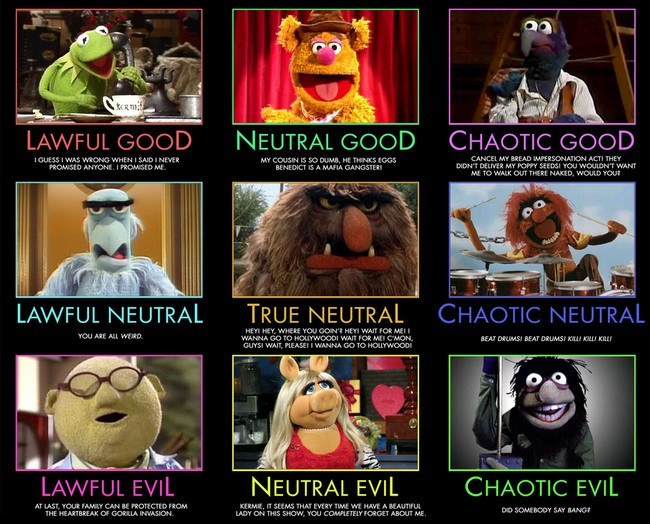
In D&D, the alignment chart is similarly split into two sections. The lawful, neutral, chaotic part of the chart and the Good, neutral, evil part. By combining the two sections players can choose between the nine standard types of alignment that D&D has become somewhat memeworthy for.

With all of that in mind, if we break the two sections of alignment apart into Jung and Vampire’s concepts of public and private we are able to imagine a more in depth idea of who our characters truly are.

If a character is lawful, their internal nature, or shadow, of good neutral or evil helps to direct their unseen impulses but their public actions still follow the ethical guidelines, or persona, of their lawful, neutral or chaotic part of their personality.

Essentially, a lawful good character and a lawful evil character may act similarly but they are motivated very differently. If a player can utilize this idea and their DM is agreeable to it, I believe they can have a more developed sense of personality for their characters.

If you’ve got questions about this or if you think I missed the mark, please feel free to comment here or on any of my other social media accounts.

Twitter & Instagram @Tabletoptheory1

Categories
Theory Application

Anxiety as a Game Master

I see a lot of posts on Reddit, YouTube, Twitter and other places about new GMs who feel unprepared to start running a campaign or GMs who are mid campaign feel like they are getting burned out, so I made a video to talk briefly about anxiety and success as a game master.

I think anxiety is an important topic because so many people play games like D&D to relieve stress. However, the game can get overwhelming because of all the pressure we put on ourselves to try and be successful in different aspects of campaign creation and preparing for our next session for our players. That desire for success can be a bit of a moving target due to the idea that we may not have figured out what success actually looks like. When that feeling gets to be consistent it can lead to anxiety about running the next game. I know it has for me.

I think that understanding anxiety could help some GMs find success. The three types of anxiety I talk about in the video are: Ego anxiety, discomfort anxiety and anxiety about anxiety.

You can watch the video I made about it here if you like:

I want to be clear, I’m not saying that you are suffering from this. I wanted to talk about it because I see GMs bringing it up from time to time and I thought going into more depth with the idea could be interesting/helpful.

For those that want to know a little more:

Ego anxiety is the type of anxiety that comes from assuming a game will be a failure. By looking at a situation as a surefire failure a DM may be assuming the worst about it before it even happens. Sometimes this is called catastrophizing or awfulizing.

Sometimes a helpful way to deal with this is take a moment and focus on the work instead of the outcome. By keeping focus on the present DMs may be less likely to focus on a future that seems intimidating. Another way to think of this is to take stock of previous successes. Has a game already been run? What was enjoyable about it in the past? What was an accomplishment made in a past game? If someone is starting from zero this can be hard, but keep in mind that every journey starts somewhere.

Discomfort anxiety comes from the expectation that a DM may feel afraid or that their emotional status will be negatively disrupted sometime in the future. Someone may not feel like they need to be the best GM ever, but they may still be afraid that any effort they make will come up short. If a person feels like they won’t be a good GM until their story is ready, they could ask themselves “How will I know when my story is ready?” or “How will I know when I feel comfortable enough to run my game?” It could also be helpful to set a goal that feels more manageable. Maybe instead of building a whole world, focusing down on the town the campaign starts in can redirect focus. By challenging themselves a GM can prove to themselves that they are more capable than they originally thought.

When someone does meet a goal it’s important to take the time to recognize and acknowledge it. It may feel corny but pointing out successes is a great way to help build up self-confidence.

Anxiety over being anxious can happen when someone notices that they’re anxious and end up focusing on the anxiety itself and not the thing that created the anxiety in the first place. This new anxiety becomes a distraction and only serves to amplify the original fear. If a DM finds themselves becoming anxious over being anxious it’s okay. Practicing acceptance of anxiety can be a really helpful way to work through it. Anxiety happens and it doesn’t make someone weak or bad.

You already have what it takes to be a great DM! Have a great day!