I think alignment in D&D isn’t explained very well in the players hand book. As a result the mechanic has received a fair amount of criticism from a lot of different players, DMs and groups. So I wanted to try and help expand on the idea of what alignment in D&D can be. As a system, 5e has become very fluid and I think that’s a good thing. As more people play the game it gets improved because of the diversity of the people playing it. That being said, Alignment has been increasingly cast away from a lot of games because 5e does kind of a poor job of trying to explain what it is, and what it represents.
So, it was with that idea in mind that I made this video.
I applied some mechanics from the 3rd edition of another RPG, Vampire: The Masquerade and a few ideas from Psychologist Carl Jung to help flesh out an idea of what I think alignment in 5e could be.
That misunderstanding may come from a poor explanation or from players wanting to branch their characters away from a particular moral trope, alignment needs some help. In order to do that I drew some inspiration from my 3rd edition Vampire the masquerade handbook and from old reliable Carl Jung.
Jung and the creators of vampire have several commonalities because they both describe part of the human personality as public and private. To Jung the public part of a person’s personality is called the persona. It represents the mask that we wear in our jobs and when we are dealing with other people. This mask serves two purposes according to Jung. Firstly it is meant to represent the social, moral and ethical rules that we agree to and try to show to the people around us. The second purpose is to help repress some of the more instinctual parts of our personality; the parts of our personalities that want to shout at the person who cuts in front of us in line or stops us from stealing money out of a wallet we find on the street. The persona is meant to keep those base instincts in check. In Freudian language this may be a combination of the ego and the super ego.
Vampire: the Masquerade uses a similar principle called demeanor. This is a character trait that is chosen during character creation and represents the public facing part of your character. And similarly to Jung’s idea the demeanor of a character is meant to cover up the private part of your character’s personality. In Vampire that private personality is called the nature. In Jung’s model the concept of nature would be referred to as the shadow.
The role of the shadow is to account for all the instinctual, aggressive, sexualized, unrestrained parts of our personality that we believe to be in conflict with the social norms that our persona, or demeanor, represent. Jung didn’t believe the shadow was evil, just that it was suppressed by the persona, or demeanor. A person needed to be aware of both parts of the personality and a allow for the equitable function of both halves.
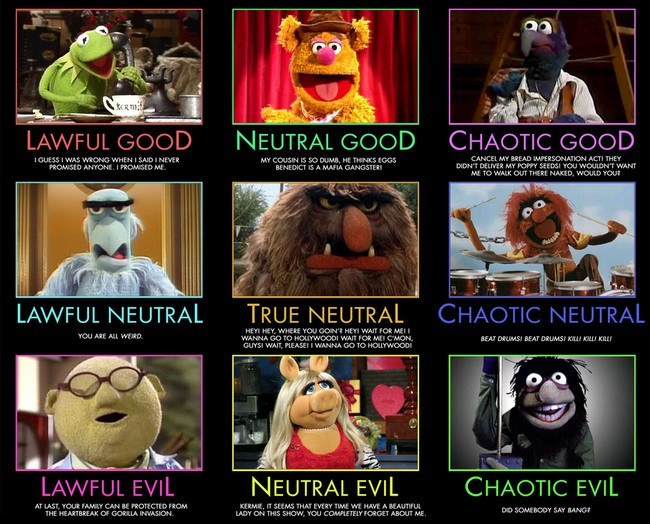
In D&D, the alignment chart is similarly split into two sections. The lawful, neutral, chaotic part of the chart and the Good, neutral, evil part. By combining the two sections players can choose between the nine standard types of alignment that D&D has become somewhat memeworthy for.
With all of that in mind, if we break the two sections of alignment apart into Jung and Vampire’s concepts of public and private we are able to imagine a more in depth idea of who our characters truly are.
If a character is lawful, their internal nature, or shadow, of good neutral or evil helps to direct their unseen impulses but their public actions still follow the ethical guidelines, or persona, of their lawful, neutral or chaotic part of their personality.
Essentially, a lawful good character and a lawful evil character may act similarly but they are motivated very differently. If a player can utilize this idea and their DM is agreeable to it, I believe they can have a more developed sense of personality for their characters.
If you’ve got questions about this or if you think I missed the mark, please feel free to comment here or on any of my other social media accounts.
A story without conflict isn’t much of a story. A quality bad guy/girl is a great way to brew conflict. Villains give heroes something to fight and the more thought you put into your story’s antagonist the better the players feel when (if) they can defeat them. Creating a quality baddie for your party gives depth to your world and story. I’ve always believed that the best villains are the heroes of their own story. Mustache twirling types that know they are evil can be fun but I’ve never found them compelling. My favorite villains from movies and books are the ones that believe they’re right. They are are so convinced of their own righteousness they either can’t or don’t care about the destruction they cause.
Part 1 of Villainous Theory
Part 2 of Villainous Theory
In an effort to provide some tips to help you create better antagonists for your stories I wanted to break down what I think are some of the key ingredients to making a great bad guy This list shouldn’t be considered exhaustive by any means. It’s a combination of character development techniques and some storytelling tricks I’ve learned from experience and other storytellers over my years as a Game Master. If you think some of these tips would be helpful for creating other parts of your world feel free to try them out.
So without further delay, here are my top six ways to develop a villain for your story.
6. MAKE THEM SYMPATHETIC
Some of the best villains are fun because they’re so evil. There’s nothing they won’t do to accomplish their evil deed. Blow up a town, kill a school bus full of orphan kittens, whatever. They have an evil plan and no sense of morality is going to stand in their way. Truly memorable villains need something else. The best villains are memorable because their motivations are relatable. Put another way, villains are the heroes of their own story. To a villain the adventuring party aren’t the good guys. As an example: Trevor was a beet farmer. Townsburg, Trevor’s homeland, was at war with Shireville. His mother died of disease when he was a child. Several years later his brothers and father were conscripted by the local magistrate. The magistrate of Townsburg pressed Trevor’s family into the local militia to fight Shireville. During a battle Trevor’s family was killed. The magistrate publicly claims that everyone pressed into service was needed for the battle but Trevor knows the magistrate was really pressing people into service who couldn’t pay taxes. Devastated by the loss of his familyTrevor swears vengeance.
Trevor is a regular person who has been traumatized. The trauma creates his motivation. Trevor’s family was taken away from him and killed in battle between two more powerful groups of people. He and his family had no control and they were taken advantage of. Trevor is furious he has so little control over his life and the lives of his family. The anger created by his sense of powerlessness is focused onto the person he sees as responsible, the magistrate. Trevor has nothing left to lose so he chooses to do something he wouldn’t normally do. Act upon his anger and make the magistrate suffer.
5. MAKE THEM EXCEPTIONAL
Everyone wants to be a gangster until it’s time to do gangster stuff. Put another way most people think they’re pretty tough until they have to prove it. That’s when they discover how much of a coward they actually are. This difference in conviction should separate the villain from other ordinary characters in your story. An antagonist that is not exceptional isn’t a villain.
A villain’s exceptionalism is their belief in their ability to accomplish a goal. Just like the heroes of the story, a villain believes they are doing the correct thing, or the thing that benefits them the most. Whatever that “Thing” turns out to be is the keystone of their motivation. It is where their exceptionalism comes from. In The Count of Monte Cristo, Edmond Dantes is so heavily invested in his quest for vengeance on the people that wrongfully imprisoned him it’s all that drives him, nearly to his own death. In Mean Girls, Regina George is so motivated by a pursuit of popularity and self image she is willing to cut down and belittle anyone who could take attention away from her.
The face of an evil dictator…
Neither Edmond nor Regina are mages or warriors. They are regular people with strong convictions. Their level of exceptionalism isn’t a magical or skill with a weapon. Martial and magical prowess can lead a regular person to ignore morality but it usually isn’t the motivation behind their villainy.
As an example: Trevor abandons his family farm and moves into the city of Townsburg. He has nothing so he steals some food and maybe some money. These thefts makes him run afoul of the local thieves guild. Trevor is attacked and beaten by the guild but does not cry or beg for mercy. Impressed by his ability to take a punch Trevor is asked to join the guild. Trevor is able to accomplish truly daring feats of theft and extortion because he has nothing left to lose. He doesn’t care if he dies or hurts anyone else. All he wants is vengeance. During this time he has used his position in the guild to learn about the magistrate that killed his family. Trevor’s criminal exploits frighten Townburg’s citizens and degrade the local economy. After a period of several years Trevor has worked his way up the ranks of the Townsburg thieves guild. Because of his focus on the magistrate and the Townsburg court he even earned a nickname: Lord Trevor.
Lord Trevor’s lack of self preservation makes him dangerous. As he survives more and more near death experiences he begins to learn. Risks that scare normal people or members of the thieves guild aren’t as concerning to Lord Trevor. While he doesn’t want to die his lack of concern for his own mortality is what makes him exceptional. He doesn’t want to die before he can kill the magistrate but his anger causes him to push his own limits. Up to this point, Lord Trevor has the makings of a successful rogue.
A note on lesser baddies:
The difference between a baddie or a less impressive bad guy and a main villain usually comes down to force of personality. A regular baddie isn’t exceptional, they’re probably a follower with very little creativity or drive of their own. A lesser baddie needs a boss to be successful. Figure out who the lesser villains in your story reports to/fears. Because it’s could help you figure out who your main villain is.
4. Make Them Flawed
A villain is a character who doesn’t adhere to the same code of morality as the heroes. This difference in morality sets up the conflict with the party and is what helps the villain justify their actions. The presence of this flaw, whatever it is, creates the conflicting difference between a hero and a villain. Without emphasizing their flaw a villain can become so sympathetic the adventuring party may join them and share their cause. Hiding a villainous flaw from the party can also help set up an eventual double cross from a character the party thought was a friendly.
As an example: Lord Trevor has become a leader of the thieves guild and now has the resources to enact his plan for revenge upon the magistrate. He begins by destroying the knights who worked for the magistrate and actually took his family. He kills some of them or ruins their lives through blackmail. Then he moves onto the magistrate. Lord Trevor targets the magistrate’s shipping company by raiding his caravans. He encourages and facilitates corruption from the magistrate’s enemies in court and eventually kidnaps the magistrate’s son and and kills him. The name Lord Trevor becomes spoken in the shadows. People fear him and his wrath. The magistrate’s shipping company closes, people lose their jobs. Nobody wants to join the magistrate’s town guard because they fear they will be killed. Without an effective town guard the city of Townsburg crumbles to Lord Trevor’s villainy.
Lord Trevor’s disregard for the people of Townsburg and the consequences of his actions are key to his villainy. His primary concern is for himself and the pain he can inflict upon the magistrate as vengeance for his family’s death. He could have become a benevolent outlaw like Zorro or Robin Hood. What makes him a Villain is his disregard for everyone but himself. Lord Trevor’s family weren’t the only ones to be killed or pressed into service during the war between the two cities. Every villain doesn’t have the same level of selfishness though. Lord Trevor’s focus on revenge is only one example of a type of Villainous flaw.
3. Know Their Goals
Villains exist for a number of reasons, but most of the time effective villains are motivated by their desire to modify things for their benefit. Antagonist’s goals may be unclear to the players or other NPCs but as the Storyteller you must know what motivates your big bad. If you know what your villain wants you will have a firmer understanding of their decisions. This doesn’t mean all of the villain’s goals should be understood by the party, just the storyteller. Some villains survive on subterfuge and need to keep their plans completely hidden from the party in order to succeed.
Almost any version of the Joker from the DC’s Batman has no clear goal except to cause mayhem or “Watch the world burn” as Michael Kane said in The Dark Knight. The Joker is effective because nobody has a clue what he actually wants. That unpredictability makes him dangerous. Even though his motives seem unclear the writing team for The Dark Knight knew exactly what the Joker’s motives were.
As an example: Lord Trevor’s motivation has always been revenge, but now that he is an accomplished criminal he can act upon his goals. When his family was killed Lord Trevor promised himself that he would make the Magistrate suffer just like he had. Young Trevor swore that he would kill the Magistrate’s family one by one. Forcing him to feel powerless as Lord Trevor hunts his family. Trevor’s ultimate goal is to make the magistrate to become so miserable and hopeless that he will eventually take his own life.
That’s pretty grim, but Lord Trevor is the villain. His goals are supposed to be evil. Having a clear understanding of Lord Trevor’s goals help the storyteller to understand the choices he makes. If the adventuring party gets in Lord Trevor’s way the storyteller already knows how he will react. The understanding of a villain’s goals not only helps to flesh out their backstory it also helps when the players ultimately end up confronting the villain. If you, as the storyteller, understand why Lord Trevor acts the way he acts he becomes a more realistic character.
2. Know How They Solve Problems
How your antagonist approaches problem solving determines how they will interact with (try to stop/kill) the adventuring party. Villains can be aggressive and bloodthirsty or cold and calculating. Their problem solving methodology shows how they approach achieving their goals. A solid understanding of their approach to resolving conflict can answer a lot of questions for a storyteller.
As an example: Despite his lack of self preservation Lord Trevor has been focused on his goal for more than a decade. He has survived and been successful by luck and hard work up to this point. He also relied upon his lack of self preservation. His willingness to take risks catches many of his targets by surprise. Because of his past successes Lord Trevor has been able to develop uncommon skills in intimidation, persuasion and sleight of hand. Lord Trevor doesn’t create convoluted plans, but he does plan. He makes sure he has the resources to achieve his goals. He finds allies in the Magistrate’s enemies and secures their help and loyalty with money and threats. When the opportunity to complete a goal is in front of him he is decisive and ruthless. Lord Trevor is open about his goals to his fellow thieves guild members because he doesn’t care what people think of him. After several weeks of planning the opportunity to kidnap another of the magistrate’s children presents itself. The child is under heavy guard but Lord Trevor attacks and successfully kidnaps the child despite sacrificing several of his own raiders and one of his own eyes in the battle.
The Magistrate knows he is under attack and knows who is killing his family. He may even know why Lord Trevor seeks vengeance. Because Lord Trevor is so direct he does not care if the magistrate knows his goals. Lord Trevor reacts quickly and decisively. He gets his hands dirty. Because of his nature the storyteller can see that Lord Trevor uses direct language and isn’t ever coy or shy. Knowing how Lord Trevor problem solves helps develop his voice.
1. Have An Evil Plan
One of the best tips I ever received as a storyteller is to “Know what your villain is going to do this session.” This tip is vital to progressing the narrative for your players. By planning out the actions of the antagonist the story continues to progress. Even if the party skews off and decides to follow some random path they weren’t supposed to, the world can keep moving. This consistent progression of events in your story world can, and usually will, help the party to get pulled back into the action you prepared for. Because you control the villain you can decide when, and if, they are successful in their agenda. If the players check out and get distracted that’s fine, the big bad gets to carry on unchecked with all their villainous deeds.
As an example: Finn and the adventuring group have been hired by a local shopkeep in Shireville to protect a caravan full of goods being sent to the Magistrate of Townsburg. During the crossing of the desert Finn and the party decide to hunt for wild game. This takes several days. Finn catches a few small spikewings and Bupkiss, the group’s barbarian, ends up wrestling a giant fire cobra into submission. A fun time is had by all. By the time the party arrives in Townsburg with the goods they discover that the town magistrate’s child has been kidnapped. The town Magistrate is under lockdown and they have nobody to pay them. Now they have to figure out what happened or not get paid.
In that example several things could have gone very differently but the main takeaway is that the party took too long to arrive at their destination. Finn and the Marauders may never know that if they hadn’t stopped to hunt they may have prevented the kidnapping. Now though, the party is in town and the abduction is all the town can think of or talk about. Lord Trevor has been successful and he can move onto his next goal.
Final Thoughts
Villains are a constant source of fun and intrigue for your players and can be given lots of attention to detail. If you can take the time to consider who the villain is, what their goals are and why they are attempting to complete them. You already have a recipe for a narrative in your story that can lead your players on a whole road of quests and plots until the inevitable confrontation with the big bad.
I see a lot of posts on Reddit, YouTube, Twitter and other places about new GMs who feel unprepared to start running a campaign or GMs who are mid campaign feel like they are getting burned out, so I made a video to talk briefly about anxiety and success as a game master.
I think anxiety is an important topic because so many people play games like D&D to relieve stress. However, the game can get overwhelming because of all the pressure we put on ourselves to try and be successful in different aspects of campaign creation and preparing for our next session for our players. That desire for success can be a bit of a moving target due to the idea that we may not have figured out what success actually looks like. When that feeling gets to be consistent it can lead to anxiety about running the next game. I know it has for me.
I think that understanding anxiety could help some GMs find success. The three types of anxiety I talk about in the video are: Ego anxiety, discomfort anxiety and anxiety about anxiety.
You can watch the video I made about it here if you like:
I want to be clear, I’m not saying that you are suffering from this. I wanted to talk about it because I see GMs bringing it up from time to time and I thought going into more depth with the idea could be interesting/helpful.
For those that want to know a little more:
Ego anxiety is the type of anxiety that comes from assuming a game will be a failure. By looking at a situation as a surefire failure a DM may be assuming the worst about it before it even happens. Sometimes this is called catastrophizing or awfulizing.
Sometimes a helpful way to deal with this is take a moment and focus on the work instead of the outcome. By keeping focus on the present DMs may be less likely to focus on a future that seems intimidating. Another way to think of this is to take stock of previous successes. Has a game already been run? What was enjoyable about it in the past? What was an accomplishment made in a past game? If someone is starting from zero this can be hard, but keep in mind that every journey starts somewhere.
Discomfort anxiety comes from the expectation that a DM may feel afraid or that their emotional status will be negatively disrupted sometime in the future. Someone may not feel like they need to be the best GM ever, but they may still be afraid that any effort they make will come up short. If a person feels like they won’t be a good GM until their story is ready, they could ask themselves “How will I know when my story is ready?” or “How will I know when I feel comfortable enough to run my game?” It could also be helpful to set a goal that feels more manageable. Maybe instead of building a whole world, focusing down on the town the campaign starts in can redirect focus. By challenging themselves a GM can prove to themselves that they are more capable than they originally thought.
When someone does meet a goal it’s important to take the time to recognize and acknowledge it. It may feel corny but pointing out successes is a great way to help build up self-confidence.
Anxiety over being anxious can happen when someone notices that they’re anxious and end up focusing on the anxiety itself and not the thing that created the anxiety in the first place. This new anxiety becomes a distraction and only serves to amplify the original fear. If a DM finds themselves becoming anxious over being anxious it’s okay. Practicing acceptance of anxiety can be a really helpful way to work through it. Anxiety happens and it doesn’t make someone weak or bad.
You already have what it takes to be a great DM! Have a great day!



 Tabletop Theory