I see a lot of posts on Reddit, YouTube, Twitter and other places about new GMs who feel unprepared to start running a campaign or GMs who are mid campaign feel like they are getting burned out, so I made a video to talk briefly about anxiety and success as a game master.
I think anxiety is an important topic because so many people play games like D&D to relieve stress. However, the game can get overwhelming because of all the pressure we put on ourselves to try and be successful in different aspects of campaign creation and preparing for our next session for our players. That desire for success can be a bit of a moving target due to the idea that we may not have figured out what success actually looks like. When that feeling gets to be consistent it can lead to anxiety about running the next game. I know it has for me.
I think that understanding anxiety could help some GMs find success. The three types of anxiety I talk about in the video are: Ego anxiety, discomfort anxiety and anxiety about anxiety.
You can watch the video I made about it here if you like:
I want to be clear, I’m not saying that you are suffering from this. I wanted to talk about it because I see GMs bringing it up from time to time and I thought going into more depth with the idea could be interesting/helpful.
For those that want to know a little more:
Ego anxiety is the type of anxiety that comes from assuming a game will be a failure. By looking at a situation as a surefire failure a DM may be assuming the worst about it before it even happens. Sometimes this is called catastrophizing or awfulizing.
Sometimes a helpful way to deal with this is take a moment and focus on the work instead of the outcome. By keeping focus on the present DMs may be less likely to focus on a future that seems intimidating. Another way to think of this is to take stock of previous successes. Has a game already been run? What was enjoyable about it in the past? What was an accomplishment made in a past game? If someone is starting from zero this can be hard, but keep in mind that every journey starts somewhere.
Discomfort anxiety comes from the expectation that a DM may feel afraid or that their emotional status will be negatively disrupted sometime in the future. Someone may not feel like they need to be the best GM ever, but they may still be afraid that any effort they make will come up short. If a person feels like they won’t be a good GM until their story is ready, they could ask themselves “How will I know when my story is ready?” or “How will I know when I feel comfortable enough to run my game?” It could also be helpful to set a goal that feels more manageable. Maybe instead of building a whole world, focusing down on the town the campaign starts in can redirect focus. By challenging themselves a GM can prove to themselves that they are more capable than they originally thought.
When someone does meet a goal it’s important to take the time to recognize and acknowledge it. It may feel corny but pointing out successes is a great way to help build up self-confidence.
Anxiety over being anxious can happen when someone notices that they’re anxious and end up focusing on the anxiety itself and not the thing that created the anxiety in the first place. This new anxiety becomes a distraction and only serves to amplify the original fear. If a DM finds themselves becoming anxious over being anxious it’s okay. Practicing acceptance of anxiety can be a really helpful way to work through it. Anxiety happens and it doesn’t make someone weak or bad.
You already have what it takes to be a great DM! Have a great day!
A GM screen is a barrier that separates the GM from the players. It helps to hide dice rolls and keep the GM’s notes private. It’s been used by storytellers for a long time without a second thought, but have you ever thought about what it represents?
I made a video about this a while back.
When I was studying counseling, one of the first lessons we were taught revolved around power dynamics. Between a counselor and a client there exists an obvious power differential. Stereotypically, the counselor is well educated about mental health and is paid by the client to help develop solutions to some apparent problem. The counselor has more inherent power than the client. An effective way to help a client develop solutions is to get them comfortable. That comfort can lead to an equalization in the power difference between the client and the counselor. Eventually this helps create more comfort for a client and develop trust.
One of the simplest ways to do that was to remove physical barriers between yourself and the client. By doing small things like not sitting in a chair that raises you above your client, and not sitting behind a desk the counselor can create a more comfortable environment. The last point about not sitting behind a desk got me thinking about the GM screen. Since it was a physical barrier between my players and I, did it create an unnecessary power dynamic?
By hiding information the GM puts their players in a position where they don’t have as much power. Some GMs require that players roll in the open and don’t obstruct the views of their character sheets. Yet the GM gets all the privacy they need. To me, this idea of privileged privacy should be examined. Not to be overthrown, but to be understood.
A Person-Centered Approach
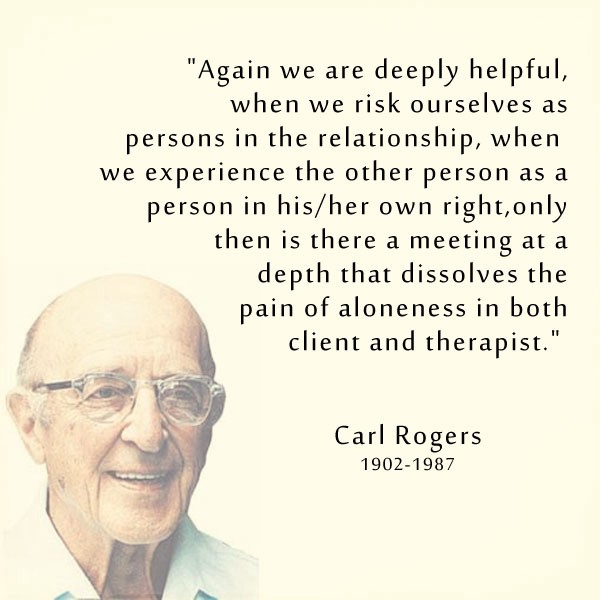
Person-centered therapy was developed by Carl Rogers. He believed everyone is different and each person traveled through life with their own set of ideals, morals and goals. Therefore their viewpoint of their world would be unique. Consequently, Carl Rogers believed that each person also had the capability to manage their own lives and should be trusted to do so.
In the traditional medical model a patient has very little agency. They listen to what the doctor tells them and then act upon their instructions. Person-centered therapy was a movement away from the therapist’s role as an expert and towards a more egalitarian approach. The client and counselor develop a more even relationship where the client is presumed to be the expert in their own life. The counselor accepts that they will never know as much about the client as the client will know about themselves.
Person-centered therapy uses three basic conditions to inform its practitioners:
Unconditional positive regard – Therapists must be empathetic and non-judgmental to convey feelings of understanding, trust, and confidence. This approach encourages clients to make their own decisions.
Empathetic understanding– Therapists accept their clients’ thoughts and feelings without invalidating them.
Congruence – Therapists carry no air of authority or professional superiority but, instead, present a true and accessible self that clients can see is honest and transparent.
Why Does This Matter?
How could storytellers use person centered principles in their games? Chances are some of you already have been doing something like this but I wanted to break down the three conditions as I feel they apply to storytelling.
Unconditional positive regard – Don’t judge a player for their choices to play a certain type of character. That player knows best about what is fun for them. Be encouraging of each player.
Empathetic understanding – Accept the reasons a player gives for their choices in game. A storyteller should not tell a player how to play their character.
Congruence – Be open to questions and be your genuine self. Affecting a mask of authority puts a wall up between your players and you. This also means that if you don’t know the answer it’s okay to take a moment to look it up.
How Do I Use This?
I take this idea one step further and I don’t use a GM screen. I don’t like them because they stop me from being able to see my players. If I really need to have access to my notes I use my laptop. If a player sees my notes or roles that’s fine. They can choose to do that, but I give them the choice.
Walls work both ways. If you put up a wall between yourself and your players to seem more authoritative you have to stay behind that wall and I think you miss out on some connections.
Another thing to consider is what kind of message a GM screen sends. Does it present you as a person of authority? Or does it make you look like you have something to hide? I feel more confident as a GM whenever I don’t hide anything from my players. Weather or not they know what comes next doesn’t matter because the world is constantly changing.
These ideas work well on a theoretical basis, but applying them to a game can be tricky. Here are some things to keep in mind.
Unconditional positiveregard – This condition may not extend to all group members all the time. Consider a group member who makes others uncomfortable. Part of being a good storyteller is finding a balance between being a good steward of the group’s needs and the individual player’s needs. In my opinion unconditional positive regard can’t be fully extented to a player who is intentionally being abusive to another player or disruptive to the game in general. A good GM can listen to what an abusive player has to say, but keeping the group productive and free of abusive behavior may not allow for unconditional positive regard at all times.
Empathetic understanding – can be difficult to maintain when a player starts to intentionally make choices in game that disrupt the experience of others. The best example of this is when a player tells the GM “I stop him!”. It’s okay if there’s something the player wants to stop that is motivated by a plot point but it’s not okay if a player does it in order to be a glory hog. Even if that’s part of a players concept.
Congruence – This concept can be tough to feel through as a storyteller because you want to have all the answers, but you probably don’t. You also have to play a bunch of different NPCs. Most GMs feel the need to take on as many roles as possible to provide maximum player engagement. So the idea of being “genuine” may seem confusing, but the idea of acting like your word is law only gets you so far.
You can make determinations on rules but stopping players from exercising free will can put a damper on the campaign. A good film director is alot like a good GM. In both cases notes can be given to an actor/player but the GM/Director can’t play the part themselves. They also should stop themselves before they tell someone how to play their character.
Yes you may be able to resolve disputes, but this does not mean that you should push your players around if they disagree with something. This applies even more if you have a player who tells you they’re not comfortable with something in the game. That type of feedback is important. Being open to players while keeping plot points secret is a balance, but the more you run games, the better you will get at it
Final Thought
Using a person centered approach may seem confusing at first but it can help you to break down some barriers between you and your players. It can get you out from behind the screen and help you create a story that follows your players. Put another way it’s the difference between having your campaign be character driven vs plot driven. Remember when the TV show for game of thrones passed the books? In the first few seasons of the show the plot followed the characters, after the show passed the books the character followed the plot. And we all remember how that turned out. The conditions of person centered therapy can give you an idea of how to get your characters at the forefront of your story by having the storyteller listen to the players and help them become the experts of their own story and the storyteller helps to write it with them.
So you want to run an RPG. Maybe you got a D&D essentials kit as a gift, found a Shadowrun core book at your local library or maybe you just finished playing your first game as a player and you want to take a crack at running your own game. Becoming a Game Master is something that can be enticing but also be truly daunting. It can feel like there’s a lot to do when you decide that you want to run your first RPG, no matter the system.
All the different things that go into running a good RPG game can feel overwhelming. How do I learn all the rules? How can I keep track of the story? How will I remember everything? The short answer to all of those questions is, you won’t. You won’t be able to learn everything before you run your first game and you won’t be totally prepared, but that’s okay.
I first started playing RPG games back when I was a wee lad of six. I knew right away that I wanted to run my own games because the idea of telling the type of story my friends would enjoy sounded like fun. When I look back on those first few games that I ran, I didn’t even use any books! Sure my mother bought me a copy of Advanced Dungeons & Dragons, but I may have only read through the book once and I know I didn’t understand most of it (what six year old understands the rules for hirelings?). When I ran my first game I don’t even think I opened the book. I just thought I knew what the rules were and if I was wrong, I just made them up new rules. I was six, I didn’t really care. My friends had fun and so did I, rules be damned!
Since that time I have run more stories than I can count in a multitude of systems. I’ve also actually bothered to read a few rulebooks. As my experience has grown I’ve learned a few basic tips that apply to any game system I run. Since they’re so universal I wanted to share some of these things I wish I knew when I was just starting out as a GM.
Check out the video I made on this over at the Tabletop Theory Youtube Channel.
Notes, Notes, Notes
Get a note pad. Whenever you’re running a game, or playing for that matter, it’s a good idea to have a notebook. Something cheap like spiral notebook will do just fine. I’ve also recently started using google drive for organizing my notes. I like google drive because I can hyperlink between different sections when I’m running a game. If I spend time writing about a city, or an organization, I can put a hyperlink into the notes I’ve written for a particular session I’m running. However, if you don’t have access to a computer when you’re playing or you just prefer to use a pencil and paper a normal blank page will get you the same results.
Names for people, places and things…
For some reason the idea of quickly coming up with names for characters is a huge stumbling block for some GMs. There’s no shame in that, naming things can be hard. How else can you explain the multitude of books written on baby naming? Add to that, a character’s name can really say a lot about them. There’s a reason Lord Voldemort doesn’t call himself Tom. Tom sounds like a guy that bags groceries. Lord Voldemort sounds like a dude that fronts for a thrash metal band.
Opening for Iron Maiden, Tom!
Creating a list of NPC names can help you to get ahead of that unease about naming someone a silly name. Creating those names in advance is something I’ve seen different GM’s use their note pads for over the years. Usually they’ll take three sheets of paper and dive them up by men’s names, women’s names and non-gendered names that can be used for people or places. As their players enter a town or encounter a random NPC they can flip over to their notes section and quickly pick a name from the list. If players ask for the name of an Inn, the GM has it ready. This type of rapid information availability can help GMs feel more confident when their players interact with an NPC they may not have been ready for. By keeping the game flowing a GM can help the players stay engrossed in the world around them.
Flavored Text
Flavor text is any text that is unrelated to rules or gameplay and is included for effect. Examples of flavor text can be a description of a city the players are entering, or a monologue from a villain. If you’re trying to develop a rich world for your players, try and pre-write some description of a new area or character that you read when your players first encounter it. Try to describe the smell and the sounds of the new city or the intricate detail of the coat that the villain is wearing. Writing down flavor text in your notebook allows you to have some dramatic elements pre-prepared for your players. Even if your players don’t enter the new city or meet the new villain right away you can have it tucked away for later.
Rules
Weather it’s D&D or Vampire: The masquerade, the game your playing is bound to have at least some rules. I’ve found my notebook a helpful place to jot down notes on rules that I may want to reference or look back at when the session is over. One example of this is the rule for grappling. I’m not sure if it’s just how I play a lot of my characters but I usually end up trying to grab other characters and throw them around. Making sure I have that rule ready to go in case any questions arise mid game is a great us of my notebook. Additionally, if any other questions come up regarding other rules mid session I like to write down the rule in question so I can go back and clarify it after the game is over.
Write down your evil plan
Write out your evil plan for your villain. This may sound simple, but it makes a huge difference. As a GM you probably want to have a villain in your story, but you don’t want to reveal everything about their plans to your players, at least not right away. I’ll probably go into greater detail about villains in another article but for now I’m going to assume you know who your villain is and what their plans are.
Keeping a list of tasks that your villain will try to accomplish each session can be a great use of your notebook. You know what’s happening with their plan even if the players are nowhere nearby. If you keep track of the progress of their evil plan you know where and when everything is happening. That way if the players are, or even aren’t, seeking out a way to stop your villain you know where things are happening and what the players will find when they arrive.
GET TO KNOW YOUR PLAYERS
Getting to know my players is essential. For most of my life I ran games for my friends. These people were my classmates, co-workers or neighbors. Regardless of how I met them, I already knew something about them before we all agreed to play D&D or some other RPG. I knew what kind of stories they enjoyed, I knew their likes and dislikes and I knew what they would like in an RPG campaign. However, as I’ve gotten older I don’t know many of the people I run games for. As a result of this I’ve become much more intentional about getting to know them.
The things I try to focus on learning about are, what types of characters they like to play, what kinds of adventures they like to be a part of and how they feel about things like combat granularity or how comfortable they are sticking to all the rules. Everyone is different but the more you learn about your group of players the easier it will be to create a game that is appealing to them. Even if you’re running something pre-prepared you can make little tweaks to it for your player’s enjoyment.
It’s not that you will necessarily change the whole story to match what they want to do, but if you learn some things they’ve done in past games that they really like, it can help you to maybe add in new elements into your storytelling. That small change will make the experience more fun for them and you. This can also allow you to challenge your own ability as a storyteller.
Familiarization > Memorization
You will never memorize everything. It’s impossible. You will always need to look stuff up. You don’t need to memorize the whole rulebook. In fact…you don’t even need to read the whole core rulebook. At least not at first. Depending on the game you are running it’s good to focus your energy on a few basic things:
Character creation rules
Basic combat mechanics
Basic Role Playing Mechanics
All the other stuff like spells, setting, monster stats can be filled in later. When you’re running your first game as a GM your priority is to tell the story and have fun. You may try your best to get all the rules right but even if you don’t it’s okay. The whole point of being a GM is to have fun while you’re playing. As long as you’re familiar with the rules of whatever game you’re playing you can develop your descriptive chops over time. After you’ve run your first couple sessions, you will eventually go back and familiarize yourself with it while going through the storytelling process. If you can get through one or two sessions you’ll find out what you need to be more familiar with based on what you may have forgotten or what your players did that you may not have expected. Later, if you’ve enjoyed your first few sessions as a GM FAMILIARIZATION NOT MEMORIZATION, it really does just make things that much easier for yourself from the beginning, and makes it feel that much less intimidating to start the storytelling process.
Mistakes will happen
It’s tough to accept sometimes but you will make mistakes. Learning from the mistakes is important. Without mistakes we cannot evolve. This is true in lots of things. Understand that if you make mistakes, or your players make mistakes, it doesn’t mean there’s anything wrong with you. It just means you get the chance to improve next time. There is a really good acronym I’ve heard from a professor of mine, OOPS, which is an acronym for: Other Opportunity For Improvement. Human beings are going to make mistakes, and it’s better to notice when you make a mistake as a storyteller (maybe point it out to your players, maybe don’t), and not to dwell on it, but keep the story moving with that knowledge in place. If you dwell too much on the mistakes you make, it can often stifle your creativity as a storyteller.
Don’t over prepare
Preparation paralysis is a real thing. I’ve seen so many would be GM’s get hung up on the idea that they don’t have enough prepared to become a GM. They don’t have enough story, or their villain isn’t scary enough, or their town doesn’t have a properly constructed calendar system.
Stop.
You don’t need all of that stuff right away! If I really wanted to make sure I had that kind of stuff prepared, I’d ask my players what kind of information they feel like they would want to know before I created my world or my campaign plots. That way I wouldn’t spend time making an intricately constructed system of planets, stars and celestial movement that my players may not care about at all. If your players eventually do express an interest in things like holidays, or history you can develop that content later. It doesn’t have to all be ready before you play.
Yes it can seem intimidating to start your first game as a GM, but I try to tell new GMs that their fear of unpreparedness isn’t something that should dictate weather or not they take that first step as a GM. Whenever someone asks me, “What’s the one thing I need to prepare to be a good GM?”
The most important thing is: be prepared, to be unprepared.
A GM cannot, ever, know what their players are going to do at all times. That level of precognition doesn’t really exist. I’ve been running games for almost thirty years and I’m still constantly surprised by the choices my players make. If I tried to prepare for every different contingency and choice that my players could make I would spend more time preparing to run my game than actually running my game. This over preparation can lean to an inverse correlation. I believe that the more time a GM spends preparing to run their game, the less likely they are to actually run their game. I’ve seen many would be GM’s get so hung up on getting their world perfect before they run their game, the opportunity to play passes them by.
Don’t get too invested in having a specific way that your plot is going to play out. Having too much of the story already laid out, without room for change, can often stop you from moving to the next plot point. Your players might make a decision that could completely derail your storyline if you’re too overprepared. If you’re going to run a game, it’s a fine thing to get familiarized with what you want to do, and what part of the story you want to tell. However, don’t over prepare.
Helmut von Moltke said that “No plan survives contact with the enemy.” Your players are not the enemy. But the inference is still true. Your players have free will and they may not go exactly where you planned. That free will is a good thing. Be prepared to be unprepared. If you know that you’ll have to think on your feet then you won’t be surprised when it happens. If you are having difficulty with the preparation process, there are a lot of good independent and official pre-planned adventures for games, that can be a good foundation for you to build your story off of. Run the first game, then you will know what you need to prepare for the next game.
Take care of yourself
Know when to say you’re done. GMs can get stuck as the #FOREVERDM, and that’s not a bad thing. I prefer to run games more than play. I also know that puts me in the minority.
If you need a break from running a game that’s fine. Tell your players. You need to have fun too. Nobody can survive on a diet of ice cream no matter how much they like it. The same thing applies to DMing. You will need to stop at some point and that’s okay. It’s a game for everyone at the table. If you’re not having fun, or the players are treating you poorly you don’t owe anyone anything. You have to take care of yourself emotionally and mentally. Playing or running a game requires you to give something of yourself. If you’re tapped out, you have nothing left to give. So, taking a break helps you recover enough to start telling the story again, but only when you’re ready.
You can do this.
A multitude of people, from every walk of life, have started running games before. You don’t need special training. There’s a lyric from the artist Talib Kweli: “if you can walk you can dance, if you can talk you can sing.” I think this spirit is true here too. If you can listen you can tell a story. If you have heard a great story before, and you want to tell your own, you can. You have all the qualifications you need already to tell a story.


 Tabletop Theory