
A GM screen is a barrier that separates the GM from the players. It helps to hide dice rolls and keep the GM’s notes private. It’s been used by storytellers for a long time without a second thought, but have you ever thought about what it represents?
When I was studying counseling, one of the first lessons we were taught revolved around power dynamics. Between a counselor and a client there exists an obvious power differential. Stereotypically, the counselor is well educated about mental health and is paid by the client to help develop solutions to some apparent problem. The counselor has more inherent power than the client. An effective way to help a client develop solutions is to get them comfortable. That comfort can lead to an equalization in the power difference between the client and the counselor. Eventually this helps create more comfort for a client and develop trust.
One of the simplest ways to do that was to remove physical barriers between yourself and the client. By doing small things like not sitting in a chair that raises you above your client, and not sitting behind a desk the counselor can create a more comfortable environment. The last point about not sitting behind a desk got me thinking about the GM screen. Since it was a physical barrier between my players and I, did it create an unnecessary power dynamic?
By hiding information the GM puts their players in a position where they don’t have as much power. Some GMs require that players roll in the open and don’t obstruct the views of their character sheets. Yet the GM gets all the privacy they need. To me, this idea of privileged privacy should be examined. Not to be overthrown, but to be understood.
A Person-Centered Approach
Person-centered therapy was developed by Carl Rogers. He believed everyone is different and each person traveled through life with their own set of ideals, morals and goals. Therefore their viewpoint of their world would be unique. Consequently, Carl Rogers believed that each person also had the capability to manage their own lives and should be trusted to do so.
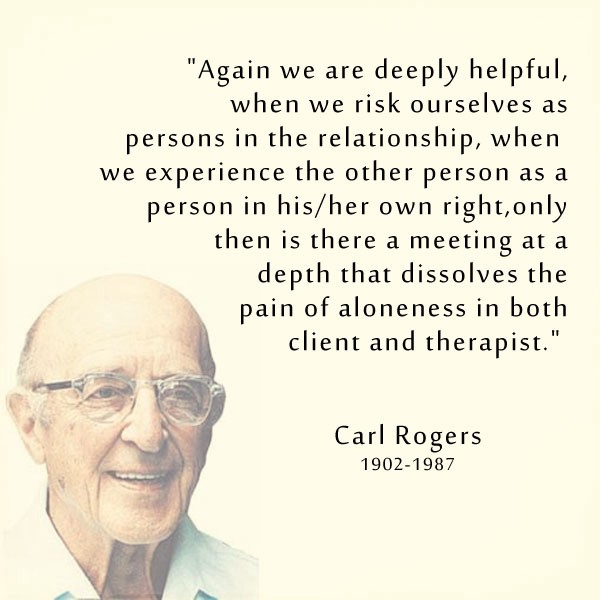
In the traditional medical model a patient has very little agency. They listen to what the doctor tells them and then act upon their instructions. Person-centered therapy was a movement away from the therapist’s role as an expert and towards a more egalitarian approach. The client and counselor develop a more even relationship where the client is presumed to be the expert in their own life. The counselor accepts that they will never know as much about the client as the client will know about themselves.
Person-centered therapy uses three basic conditions to inform its practitioners:
- Unconditional positive regard – Therapists must be empathetic and non-judgmental to convey feelings of understanding, trust, and confidence. This approach encourages clients to make their own decisions.
- Empathetic understanding– Therapists accept their clients’ thoughts and feelings without invalidating them.
- Congruence – Therapists carry no air of authority or professional superiority but, instead, present a true and accessible self that clients can see is honest and transparent.
Why Does This Matter?
How could storytellers use person centered principles in their games? Chances are some of you already have been doing something like this but I wanted to break down the three conditions as I feel they apply to storytelling.
- Unconditional positive regard – Don’t judge a player for their choices to play a certain type of character. That player knows best about what is fun for them. Be encouraging of each player.
- Empathetic understanding – Accept the reasons a player gives for their choices in game. A storyteller should not tell a player how to play their character.
- Congruence – Be open to questions and be your genuine self. Affecting a mask of authority puts a wall up between your players and you. This also means that if you don’t know the answer it’s okay to take a moment to look it up.
How Do I Use This?
I take this idea one step further and I don’t use a GM screen. I don’t like them because they stop me from being able to see my players. If I really need to have access to my notes I use my laptop. If a player sees my notes or roles that’s fine. They can choose to do that, but I give them the choice.
Walls work both ways. If you put up a wall between yourself and your players to seem more authoritative you have to stay behind that wall and I think you miss out on some connections.
Another thing to consider is what kind of message a GM screen sends. Does it present you as a person of authority? Or does it make you look like you have something to hide? I feel more confident as a GM whenever I don’t hide anything from my players. Weather or not they know what comes next doesn’t matter because the world is constantly changing.
These ideas work well on a theoretical basis, but applying them to a game can be tricky. Here are some things to keep in mind.
Unconditional positive regard – This condition may not extend to all group members all the time. Consider a group member who makes others uncomfortable. Part of being a good storyteller is finding a balance between being a good steward of the group’s needs and the individual player’s needs. In my opinion unconditional positive regard can’t be fully extented to a player who is intentionally being abusive to another player or disruptive to the game in general. A good GM can listen to what an abusive player has to say, but keeping the group productive and free of abusive behavior may not allow for unconditional positive regard at all times.
Empathetic understanding – can be difficult to maintain when a player starts to intentionally make choices in game that disrupt the experience of others. The best example of this is when a player tells the GM “I stop him!”. It’s okay if there’s something the player wants to stop that is motivated by a plot point but it’s not okay if a player does it in order to be a glory hog. Even if that’s part of a players concept.
Congruence – This concept can be tough to feel through as a storyteller because you want to have all the answers, but you probably don’t. You also have to play a bunch of different NPCs. Most GMs feel the need to take on as many roles as possible to provide maximum player engagement. So the idea of being “genuine” may seem confusing, but the idea of acting like your word is law only gets you so far.
You can make determinations on rules but stopping players from exercising free will can put a damper on the campaign. A good film director is alot like a good GM. In both cases notes can be given to an actor/player but the GM/Director can’t play the part themselves. They also should stop themselves before they tell someone how to play their character.
Yes you may be able to resolve disputes, but this does not mean that you should push your players around if they disagree with something. This applies even more if you have a player who tells you they’re not comfortable with something in the game. That type of feedback is important. Being open to players while keeping plot points secret is a balance, but the more you run games, the better you will get at it
Final Thought
Using a person centered approach may seem confusing at first but it can help you to break down some barriers between you and your players. It can get you out from behind the screen and help you create a story that follows your players. Put another way it’s the difference between having your campaign be character driven vs plot driven. Remember when the TV show for game of thrones passed the books? In the first few seasons of the show the plot followed the characters, after the show passed the books the character followed the plot. And we all remember how that turned out. The conditions of person centered therapy can give you an idea of how to get your characters at the forefront of your story by having the storyteller listen to the players and help them become the experts of their own story and the storyteller helps to write it with them.
 Tabletop Theory