Categories
Theory Application

How RPGs like D&D Help us Make Friends

I made a video about how RPGs like Dungeons & Dragons help people make friends based on sociological and primatological research. You can watch it below if you’d like.

If you’d like to read about it, please continue.

Friends are pretty great and If you’ve played any RPGs in the past then it’s pretty likely that you’ve developed some good friends in the process. But why? How does that work? Are RPGs really that good at helping people make friends?

Well, Yes, playing RPGs can meet all the conditions to help the people create long lasting friendships. But the interesting thing isn’t that RPGs do this. The interesting thing is how RPGs create friendships. In order to understand that we need to understand a few other things first. Basic things, like what is a friend and how friendships are formed and what purpose they serve on a biological level.

What is friendship?

Defining friendship as a social behavior is pretty simple. According to psychologist Robert Seyfarth: “Friendship is a long-term, positive relationship that involves cooperation.” He and a team of other scientists discovered that by researching primates. The team spent a great deal of time observing different types of monkeys and baboons in Africa and observed that animals with strong social networks, like friendships, have longer lifespans and actually reproduce more. Friends and people who we can rely upon are there to help us deal with difficult situations in life. And while most people aren’t worried about being eaten by predatory animals anymore, the stress response still exists in humans. So apparently one of the ways we cope with those stresses is to create friendship bonds with other people. We do this in order to help reduce the amount of stress we accumulate during our day to day lives.

How do we make friends?

Researchers have known for a while now what three key building blocks are that allow us to make friends.

Proximity

Repeated interactions

And

a setting where we feel comfortable enough let our guard down

And, you remember those monkeys that Sayfarth and his team were studying? They noticed several behaviors that helped to reinforce these principals. They discovered that those same monkeys spent a lot of time together. They saw that certain monkeys chose to spend time grooming other certain monkeys expressing preferences. Those choices of who grooms who eventually led to closer connections. But why does that matter?

Why do our friends matter?

Well, Sayfarth’s team found a few other conditions that were present when the monkeys were making friends. Namely:

The amount of time spent with friends

The positive outcome of that spent time

And

An equitable return of effort.

They noticed that the monkeys spent around 20 percent of all their waking time grooming each other. Looking at the response in the monkey’s neurotransmitters, or brain chemistry a positive outcome of all that grooming was seen. Their brains were releasing oxytocin and endorphins. These are the chemicals that help us to feel safe, cared for and help to create bonds with each other. After they spent enough time with each other the monkeys developed relationships that were equally helpful to both parties. But the final piece of the puzzle was an equitable return of effort. Because if one monkey spent a good amount of time grooming another and the favor wasn’t returned then a friendship wouldn’t develop. But the team found some monkeys would spend equal time grooming one another. That equity in grooming helped the monkeys to learn that their friend would help them and eventually help deal with larger issues. Like the stress of predation.

Humans have been at the top of the food chain for a very long time. Yet we still get stressed out. That’s because there are still loads of other stressors that we face on a regular basis. Each person has their own set of troubles and issues but they also have their own set of coping skills. When we have a friend though, it helps us to develop additional resources and help mitigate stress through interaction, because brain chemicals like oxytocin can help to alleviate the effects of stress chemicals in our brains like cortisol.

What does this have to do with RPGs?

Meeting new people is tricky and how do you know if that new person has anything in common with you? Well, sometimes it helps to have a way to jumpstart those relationships. This can be called a common interest. If you’ve read this far you are at least passively familiar with games like Dungeons & Dragons or some other kind of role playing game. So let’s consider what RPGs do through the lens of the traditional sociological understanding of friendship.

The original list had three qualities:

Proximity

Repeated interactions

And

a setting where we feel comfortable enough let our guard down

If you consider what a standard in person role playing group looks like you immediately can see how all three of those conditions are met. The people playing the game are in close proximity to one another. They’re literally at the same table.

Now there is some question, at least to me, about whether or not a group that meets completely online still meets the same criteria for proximity since the group isn’t in the same physical location but I honestly couldn’t find any research about the difference between relationships that exist completely online vs in person in this context for RPGs. From my own experience I always find myself creating stronger bonds with people that I meet in person at some point. That’s not to say that a completely long distance virtual friendship can’t be helpful or valuable, just that everyone has their own criteria for how much of that proximity needs to be physical compared to virtual. I’m gonna bet since coronavirus made us all experts on how to video conference there’s gonna be some really interesting research released in the next few years that addresses that specific question, but I digress.

Because whether or not your group meets in person or online their goal is probably to meet on a regular basis. If they do, then you can also tick off repeated interactions. Even if one or two people miss a session from time to time there is still an expectation that some day of the week, or month, time will be put aside for D&D or whatever you’re playing. This aspect of repeated interaction is, at least anecdotally, one of the things that people struggle with the most when it comes to getting into the RPG hobby, especially if they join the hobby after college and they’ve already got a full time job and a family. But assuming everyone can get some time on saturday nights the repeat interactions are taken care of. That just leaves an environment where people can feel comfortable enough to let their guard down.

Generally speaking, a table where people are playing an RPG is a pretty welcoming place. People are sharing a common story, building a world, using their imaginations, cooperating, collaborating and hopefully having a good time. People get to share their ideas and characters that they’ve created and tell a story that they find fun and engaging. That type of expression necessitates a certain level of vulnerability. If people are new to the hobby it may be tough to find a table to play at but once people do find a supportive table they still feel comfortable enough to let their guard down and share their creativity. At least in a perfect world.

Because all three of the traditional pillars of making friends are handled readily by a normal RPG table, but what about Sayfarth’s team and the monkeys they studied? Do RPGs still stack up with the other conditions?

Monkey’s and D&D

So remember, the pillars of monkey friendship were:

The amount of time spent with friends

The positive outcome of that spent time

And

An equitable return of effort.

Any RPG group that I’ve ever been a part of meets for at least two hours. When I was younger, those sessions sometimes lasted for an entire weekend. So of course the amount of time that a group of players and a GM spend together is going to be quite a bit. Factoring in the traditional idea of repeated interaction you can see that the amount of time people spend playing RPGs with their player group almost automatically nets them lots of points on their way to friendships. But time and repetition aren’t everything. Think about people who are out in the workforce. I spend at least 40 to 50 hours with the same people at work every week but I spend very little if any of my time out of work with them. Does that mean they aren’t my friends? Not necessarily. Everyone is different and people may indeed make lasting excellent friendships with co-workers but some work environments are very competitive. This competition means it can be hard to meet one of the original criteria for friendship, having a setting where people can feel comfortable enough to let their guard down. So even though we can spend a great deal of time with people, time isn’t the only factor that creates friendships; the environment plays a big part. Just think about school. You can spend years in class with the same people and not even learn their names.

That’s why it’s so important to remember the other parts of how friendship was observed with the monkeys. The positive outcome of time spent with people is a massive part of what creates friendships. At an RPG table the group is not in competition with each other or the game master. They are all working together in order to tell the same story. The positive outcome of which doesn’t have to be completing an arc or even keeping a character alive. The positive outcome is the social interaction that occurs at the table. I’ve played at a lot of tables where we spent a ton of time just talking about the rules, planning our next move or just going to a pub in game and pretending to order food. The plot may or may not move and the characters may be our focus or be completely forgotten, but the positive outcome of that social interaction is the release of those chemicals that help us feel safe and valued. Oxytocin and endorphins are released when we spend time doing something pleasurable like laughing, singing, and storytelling. I’ve done these things at the table before and if the vast amount of RPG content on the internet is any indication, I’m not alone. We enjoy RPGs because they help us to scratch a lot of social itches.

Which dovetails real nicely into the final part of what Sayfarth’s monkeys showed, an equitable return of effort. RPG groups allow for us to contribute to a story and bring our creative ideas to life. When all the players put forth effort and try to show the other members of the table that they care, players and GMs can hopefully see it for what it is, putting out effort. This may sound like trading off GM duties, but not necessarily. Sometimes people just prefer to run the game and sometimes people aren’t comfortable as the GM. Personally I don’t see anything wrong with that. I don’t think that a player needs to show they care by taking a turn as a GM. If a player wants to take a turn as a game master I would rather they do it because they want to, not because they feel like they have to or that they’ll lose friends if they don’t. Because people don’t always put out effort the same way. Some players know the rules, some are good at tactics, some take excellent notes and some always remember to bring snacks. There are so many examples and so many different ways that I’ve seen players show they care about the game and the people they play with. If we, as players and GMs take the time to acknowledge and appreciate the care and attention that the other players bring to the table then we are able to appreciate each other not just for the value we bring to the game, but the value we bring to each others lives. Because in my experience many of my lifelong friends have one thing in common. At some point I have played an RPG with them and during that time we were able to tick all the boxes that make up a friendship.
Categories
Theory Application

Trust at the RPG table

Why does trust matter between a GM and the players?

Trust can help create a sense of security for players to feel like their ideas will be heard and generate a sense of predictability in game.

An RPG table is a place full of wonder, intrigue, fun, laughter and perhaps most importantly, vulnerability. The relationship between the GM and the players requires that each person give of themselves. Sometimes it’s creativity in world building, sometimes it’s taking the risk of using a funny voice or accent. In each case showing a creative idea at an RPG table requires people to be vulnerable. Some ideas require more vulnerability than others, but no matter how much a player feels vulnerable a solid foundation of trust can help players to feel comfortable enough to express their ideas.

I made a video about this topic and you can watch it here if you’re interested.

In the video I talk about a few different things like:

Power dynamicsAs a GM you are someone with authority. Try not to abuse it. Players naturally know less about the world and therefore have less power than you. Try your best not put players into situations where they are uncomfortable.

Carl Jung expressed his opinions on power dynamics very effectively when he developed the three conditions of person centered therapy. I try to remain true to these conditions as a GM to keep the game focused on the players. Here are the three conditions:

Unconditional Positive Regard is when therapists/GMs must be empathetic and non-judgmental to convey their feelings of understanding, trust, and confidence that encourage their clients/players to make their own decisions and choices.

Empathetic Understanding means therapists/GMs accept their clients’ thoughts and feelings. This acceptance may push a GMs boundaries but that initial empathy helps to avoid a sense of moral superiority or condescension from the therapist/GM.

Congruence is when a therapist/GM carries no air of authority or professional superiority but, instead, presents a true and accessible self that clients can see is honest and transparent.

Group Norms/Informed Consent

If you’re starting with a new group of players for the first time, talk with your group during session zero and establish some ground rules for the game. This is not an essential step for all groups but some small time given to this in the beginning can help hold group members accountable.

This is especially helpful if you are running a game for people you don’t know. Consent helps to resolve some disputes because it helps players and GMs to know when certain lines are crossed and helps to keep people accountable. There is an invaluable resource from Monte Cook games about this topic that I suggest you take a look at if you’re interested in learning more about this idea.

You can find a link to their resource here:

Consistency of the Rules

Nothing stings a player more when the GM changes the rules for one player and not another. Some groups are only by the book and are less flexible regarding rules during the game. You need to determine what kind of game you are planning on playing. If you do change a rule record that change and try to be consistent with it. If you are corrected by a player be open to the correction. Don’t just smack it down if it’s inconvenient.

Regularity of Sessions

Set a scheduled game and establish when it will occur. Stick to that schedule. If people back out or flake out that’s fine, but if you care about running a game this step will help potential players know how serious you are.

That does not mean that you cannot cancel sessions if you need to, but it does mean that as a GM you need to be conscious enough of your own schedule and level of energy to commit to running a game as regularly as you feel comfortable.

Mixing up Facts

If your player needs to pray to their god in order to activate a divine ability. don’t punish them if they forget the name of their god, or mispronounce it. Nothing erodes trust faster than punishing a player for something small and inconsequential.

Model the behavior you’re looking for.

“Play is often talked about as if it were relief from serious learning, but for children play is serious learning. At various times play is a way to cope with life and to prepare for adulthood. Play is a way to solve problems and express feelings.”

– You are special, Fred Rogers.

Nothing speaks more loudly than the Game Master’s behavior, which influences player action and has the potential to drive their choices. If you say teamwork is important, reinforce the point by rewarding teamwork with your players. Or show a group of NPCs using the behavior you hope your players to emulate. Give credit when people do great work and you’ll set the stage for an appreciative culture.

Categories
Theory Application

Active Listening as a Game Master

Listening to your players is a key component of being a successful game master. Listening successfully means, being able to not only listen to your players ideas but also devote your attention to them enough so they feel heard and valued. Something that has helped accomplish this over the last few years has been something called Active Listening.

For those that may not be familiar with this idea I made a video about it that you can watch here:

Breaking down the idea of active listening can be accomplished with a few basic ideas:

Active listening refers to a pattern of listening that keeps you engaged with your players (or someone else) in a positive way. You will be listening attentively while they speak, trying to quiet your own mind and withholding judgment and advice.

The most important part of that definition is listening attentively while someone else speaks. A lot of the time when people are having a conversation one person is just waiting for their turn to speak, or as they’re listening to another person they’re building their own set of information in order to best or one up the other person. That’s not to say that kind of conversation is bad or unreasonable.

I know I used to do that all the time and I still do find myself doing it from time to time. But the thing about active listening is that when you’re doing it, you’re devoting your attention completely to what the other person is saying instead of just waiting for your turn to speak.

This may sound obvious, but it can be harder than you think. When I’m running a D&D session I want to listen to what my players are saying because I want to use their input in the game. However, there is also a deeper level to it that I try to keep in mind.

The most important and most difficult part of listening is learning how to shut down your internal dialogue while listening. Try and avoid thinking about what happens next in game and just listen to the player. It is impossible to attentively listen to someone else and your own internal voice at the same time. This may seem obvious but it’s actually quite difficult and can take a long time to learn how to do.

Something else that can be hard sometimes is being open, neutral, and withhold judgment while listening. As a Game Master your job is to be the storyteller of your universe. To me, that usually means striving for some measure of neutrality and impartiality between the players and their ideas. So weather or not you feel like their ideas are stupid or disruptive try and give your players the benefit of the doubt, at least initially. If you have a player who is being intentionally disruptive you can and should step in to have a conversation with that player. But most of the time, if a player has what you may consider to be a “bad idea” try and reserve your initial judgment.

Something else that can make a big difference for listening to your players is your comfort with silence. It’s okay to be okay with silence. When a player, or you, for that matter need a moment to think about what comes next you can allow for some silence. Letting people think doesn’t stop the game from progressing. Sometimes the difference between a player losing focus and a great idea is just a few moments of silent contemplation.

There’s a lot of moving parts to active listening but I think it’s an important skill that can really help GMs learn how to bring their player’s ideas into your story and your world. A player who feels validated and listened to will usually, in my experience, be more involved in the game.

Categories
Theory Application

D&D Alignment, Vampires and Carl Jung

I think alignment in D&D isn’t explained very well in the players hand book. As a result the mechanic has received a fair amount of criticism from a lot of different players, DMs and groups. So I wanted to try and help expand on the idea of what alignment in D&D can be. As a system, 5e has become very fluid and I think that’s a good thing. As more people play the game it gets improved because of the diversity of the people playing it. That being said, Alignment has been increasingly cast away from a lot of games because 5e does kind of a poor job of trying to explain what it is, and what it represents.

So, it was with that idea in mind that I made this video.

I applied some mechanics from the 3rd edition of another RPG, Vampire: The Masquerade and a few ideas from Psychologist Carl Jung to help flesh out an idea of what I think alignment in 5e could be.

That misunderstanding may come from a poor explanation or from players wanting to branch their characters away from a particular moral trope, alignment needs some help. In order to do that I drew some inspiration from my 3rd edition Vampire the masquerade handbook and from old reliable Carl Jung.

Jung and the creators of vampire have several commonalities because they both describe part of the human personality as public and private. To Jung the public part of a person’s personality is called the persona. It represents the mask that we wear in our jobs and when we are dealing with other people. This mask serves two purposes according to Jung. Firstly it is meant to represent the social, moral and ethical rules that we agree to and try to show to the people around us. The second purpose is to help repress some of the more instinctual parts of our personality; the parts of our personalities that want to shout at the person who cuts in front of us in line or stops us from stealing money out of a wallet we find on the street. The persona is meant to keep those base instincts in check. In Freudian language this may be a combination of the ego and the super ego.

Vampire: the Masquerade uses a similar principle called demeanor. This is a character trait that is chosen during character creation and represents the public facing part of your character. And similarly to Jung’s idea the demeanor of a character is meant to cover up the private part of your character’s personality. In Vampire that private personality is called the nature. In Jung’s model the concept of nature would be referred to as the shadow.

The role of the shadow is to account for all the instinctual, aggressive, sexualized, unrestrained parts of our personality that we believe to be in conflict with the social norms that our persona, or demeanor, represent. Jung didn’t believe the shadow was evil, just that it was suppressed by the persona, or demeanor. A person needed to be aware of both parts of the personality and a allow for the equitable function of both halves.

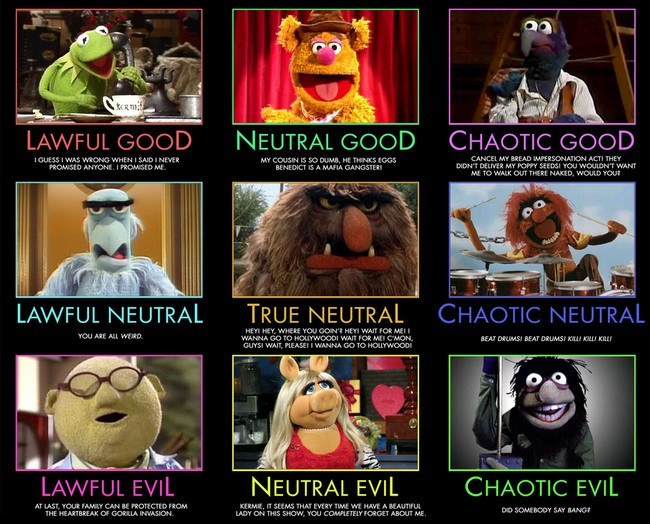
In D&D, the alignment chart is similarly split into two sections. The lawful, neutral, chaotic part of the chart and the Good, neutral, evil part. By combining the two sections players can choose between the nine standard types of alignment that D&D has become somewhat memeworthy for.

With all of that in mind, if we break the two sections of alignment apart into Jung and Vampire’s concepts of public and private we are able to imagine a more in depth idea of who our characters truly are.

If a character is lawful, their internal nature, or shadow, of good neutral or evil helps to direct their unseen impulses but their public actions still follow the ethical guidelines, or persona, of their lawful, neutral or chaotic part of their personality.

Essentially, a lawful good character and a lawful evil character may act similarly but they are motivated very differently. If a player can utilize this idea and their DM is agreeable to it, I believe they can have a more developed sense of personality for their characters.

If you’ve got questions about this or if you think I missed the mark, please feel free to comment here or on any of my other social media accounts.

Twitter & Instagram @Tabletoptheory1

Categories
Theory Application

Anxiety as a Game Master

I see a lot of posts on Reddit, YouTube, Twitter and other places about new GMs who feel unprepared to start running a campaign or GMs who are mid campaign feel like they are getting burned out, so I made a video to talk briefly about anxiety and success as a game master.

I think anxiety is an important topic because so many people play games like D&D to relieve stress. However, the game can get overwhelming because of all the pressure we put on ourselves to try and be successful in different aspects of campaign creation and preparing for our next session for our players. That desire for success can be a bit of a moving target due to the idea that we may not have figured out what success actually looks like. When that feeling gets to be consistent it can lead to anxiety about running the next game. I know it has for me.

I think that understanding anxiety could help some GMs find success. The three types of anxiety I talk about in the video are: Ego anxiety, discomfort anxiety and anxiety about anxiety.

You can watch the video I made about it here if you like:

I want to be clear, I’m not saying that you are suffering from this. I wanted to talk about it because I see GMs bringing it up from time to time and I thought going into more depth with the idea could be interesting/helpful.

For those that want to know a little more:

Ego anxiety is the type of anxiety that comes from assuming a game will be a failure. By looking at a situation as a surefire failure a DM may be assuming the worst about it before it even happens. Sometimes this is called catastrophizing or awfulizing.

Sometimes a helpful way to deal with this is take a moment and focus on the work instead of the outcome. By keeping focus on the present DMs may be less likely to focus on a future that seems intimidating. Another way to think of this is to take stock of previous successes. Has a game already been run? What was enjoyable about it in the past? What was an accomplishment made in a past game? If someone is starting from zero this can be hard, but keep in mind that every journey starts somewhere.

Discomfort anxiety comes from the expectation that a DM may feel afraid or that their emotional status will be negatively disrupted sometime in the future. Someone may not feel like they need to be the best GM ever, but they may still be afraid that any effort they make will come up short. If a person feels like they won’t be a good GM until their story is ready, they could ask themselves “How will I know when my story is ready?” or “How will I know when I feel comfortable enough to run my game?” It could also be helpful to set a goal that feels more manageable. Maybe instead of building a whole world, focusing down on the town the campaign starts in can redirect focus. By challenging themselves a GM can prove to themselves that they are more capable than they originally thought.

When someone does meet a goal it’s important to take the time to recognize and acknowledge it. It may feel corny but pointing out successes is a great way to help build up self-confidence.

Anxiety over being anxious can happen when someone notices that they’re anxious and end up focusing on the anxiety itself and not the thing that created the anxiety in the first place. This new anxiety becomes a distraction and only serves to amplify the original fear. If a DM finds themselves becoming anxious over being anxious it’s okay. Practicing acceptance of anxiety can be a really helpful way to work through it. Anxiety happens and it doesn’t make someone weak or bad.

You already have what it takes to be a great DM! Have a great day!

Categories
Theory Application

The Player as the Expert

A GM screen is a barrier that separates the GM from the players. It helps to hide dice rolls and keep the GM’s notes private. It’s been used by storytellers for a long time without a second thought, but have you ever thought about what it represents?

I made a video about this a while back.

When I was studying counseling, one of the first lessons we were taught revolved around power dynamics. Between a counselor and a client there exists an obvious power differential. Stereotypically, the counselor is well educated about mental health and is paid by the client to help develop solutions to some apparent problem. The counselor has more inherent power than the client. An effective way to help a client develop solutions is to get them comfortable. That comfort can lead to an equalization in the power difference between the client and the counselor. Eventually this helps create more comfort for a client and develop trust.

One of the simplest ways to do that was to remove physical barriers between yourself and the client. By doing small things like not sitting in a chair that raises you above your client, and not sitting behind a desk the counselor can create a more comfortable environment. The last point about not sitting behind a desk got me thinking about the GM screen. Since it was a physical barrier between my players and I, did it create an unnecessary power dynamic?

By hiding information the GM puts their players in a position where they don’t have as much power. Some GMs require that players roll in the open and don’t obstruct the views of their character sheets. Yet the GM gets all the privacy they need. To me, this idea of privileged privacy should be examined. Not to be overthrown, but to be understood.

A Person-Centered Approach

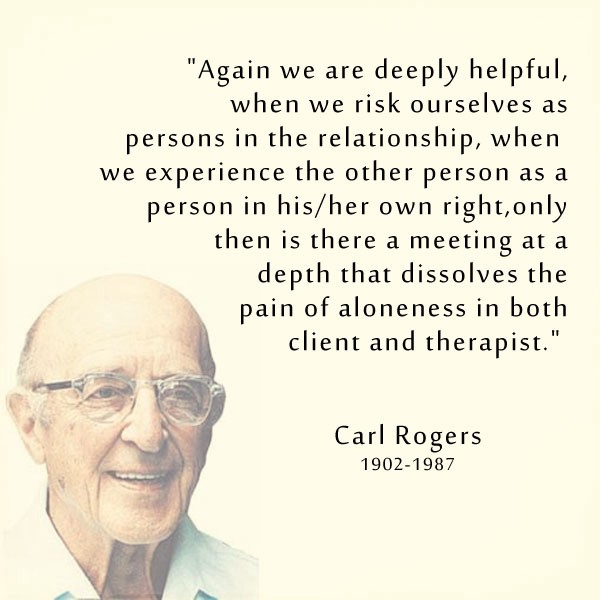
Person-centered therapy was developed by Carl Rogers. He believed everyone is different and each person traveled through life with their own set of ideals, morals and goals. Therefore their viewpoint of their world would be unique. Consequently, Carl Rogers believed that each person also had the capability to manage their own lives and should be trusted to do so. 

In the traditional medical model a patient has very little agency. They listen to what the doctor tells them and then act upon their instructions. Person-centered therapy was a movement away from the therapist’s role as an expert and towards a more egalitarian approach. The client and counselor develop a more even relationship where the client is presumed to be the expert in their own life. The counselor accepts that they will never know as much about the client as the client will know about themselves.

Person-centered therapy uses three basic conditions to inform its practitioners:

  1. Unconditional positive regard – Therapists must be empathetic and non-judgmental to convey feelings of understanding, trust, and confidence. This approach encourages clients to make their own decisions.
  2. Empathetic understanding– Therapists accept their clients’ thoughts and feelings without invalidating them.
  3. Congruence – Therapists carry no air of authority or professional superiority but, instead, present a true and accessible self that clients can see is honest and transparent.

Why Does This Matter?

How could storytellers use person centered principles in their games? Chances are some of you already have been doing something like this but I wanted to break down the three conditions as I feel they apply to storytelling.

  1. Unconditional positive regard – Don’t judge a player for their choices to play a certain type of character. That player knows best about what is fun for them. Be encouraging of each player.
  2. Empathetic understanding – Accept the reasons a player gives for their choices in game. A storyteller should not tell a player how to play their character.
  3. Congruence – Be open to questions and be your genuine self. Affecting a mask of authority puts a wall up between your players and you. This also means that if you don’t know the answer it’s okay to take a moment to look it up.

How Do I Use This?

I take this idea one step further and I don’t use a GM screen. I don’t like them because they stop me from being able to see my players. If I really need to have access to my notes I use my laptop. If a player sees my notes or roles that’s fine. They can choose to do that, but I give them the choice.

Walls work both ways. If you put up a wall between yourself and your players to seem more authoritative you have to stay behind that wall and I think you miss out on some connections.

Another thing to consider is what kind of message a GM screen sends. Does it present you as a person of authority? Or does it make you look like you have something to hide? I feel more confident as a GM whenever I don’t hide anything from my players. Weather or not they know what comes next doesn’t matter because the world is constantly changing.

These ideas work well on a theoretical basis, but applying them to a game can be tricky. Here are some things to keep in mind.

Unconditional positive regard – This condition may not extend to all group members all the time. Consider a group member who makes others uncomfortable. Part of being a good storyteller is finding a balance between being a good steward of the group’s needs and the individual player’s needs. In my opinion unconditional positive regard can’t be fully extented to a player who is intentionally being abusive to another player or disruptive to the game in general. A good GM can listen to what an abusive player has to say, but keeping the group productive and free of abusive behavior may not allow for unconditional positive regard at all times.

Empathetic understanding – can be difficult to maintain when a player starts to intentionally make choices in game that disrupt the experience of others. The best example of this is when a player tells the GM “I stop him!”. It’s okay if there’s something the player wants to stop that is motivated by a plot point but it’s not okay if a player does it in order to be a glory hog. Even if that’s part of a players concept.

Congruence – This concept can be tough to feel through as a storyteller because you want to have all the answers, but you probably don’t. You also have to play a bunch of different NPCs. Most GMs feel the need to take on as many roles as possible to provide maximum player engagement. So the idea of being “genuine” may seem confusing, but the idea of acting like your word is law only gets you so far.

You can make determinations on rules but stopping players from exercising free will can put a damper on the campaign. A good film director is alot like a good GM. In both cases notes can be given to an actor/player but the GM/Director can’t play the part themselves. They also should stop themselves before they tell someone how to play their character.

 Yes you may be able to resolve disputes, but this does not mean that you should push your players around if they disagree with something. This applies even more if you have a player who tells you they’re not comfortable with something in the game. That type of feedback is important. Being open to players while keeping plot points secret is a balance, but the more you run games, the better you will get at it

Final Thought

Using a person centered approach may seem confusing at first but it can help you to break down some barriers between you and your players. It can get you out from behind the screen and help you create a story that follows your players.  Put another way it’s the difference between having your campaign be character driven vs plot driven. Remember when the TV show for game of thrones passed the books? In the first few seasons of the show the plot followed the characters, after the show passed the books the character followed the plot. And we all remember how that turned out. The conditions of person centered therapy can give you an idea of how to get your characters at the forefront of your story by having the storyteller listen to the players and help them become the experts of their own story and the storyteller helps to write it with them.